Choosing the wrong raised flooring supplier can be a costly mistake—one that haunts your project for years. Imagine this: You’ve selected a supplier based on a low quote. The panels arrive late. The installation is rushed. Within months, panels begin to rock, pedestals shift, and accessing the cables beneath becomes a nightmare. Your data center’s cooling efficiency drops, maintenance costs soar, and every minor change requires disruptive, expensive work. This scenario plays out more often than industry professionals care to admit.
The truth is, a raised flooring supplier is not merely a vendor who delivers boxes of panels. They are a strategic partner whose expertise, quality standards, and support capabilities directly determine your project’s long-term operational success. In the Gulf region’s fast-paced construction environment—where Vision 2030 projects demand excellence, speed, and reliability—the choice of partner matters enormously. This guide will walk you through everything you need to know about selecting the right raised flooring supplier, understanding the difference between suppliers, manufacturers, and support providers, and why partnering with an integrated solution provider like SFS (Specialized Flooring Systems) is the smartest investment you can make for your building’s infrastructure.

What Does a Raised Flooring Supplier Really Do?
At first glance, the role of a raised flooring supplier seems straightforward: provide the panels, pedestals, and accessories needed to install a raised access floor. However, this simplistic view misses the full scope of what a true professional partner brings to your project.
A reputable raised flooring supplier does far more than take orders and ship products. Their responsibilities include:
-
Technical consultation during design phase: Advising on optimal plenum height, load requirements, and panel types based on your specific application.
-
Product specification assistance: Helping engineers and architects select the correct materials, finishes, and performance ratings.
-
Quality assurance: Supplying products that meet international standards (EN, ISO) and local regulatory requirements.
-
Logistics and supply chain management: Ensuring materials arrive on-site exactly when needed, preventing costly project delays.
-
Installation supervision or execution: Providing trained technicians or overseeing certified installers to ensure proper assembly.
-
Post-installation support: Offering maintenance guidance, troubleshooting, and access to spare parts.
When you evaluate a raised flooring supplier, you are not just evaluating a product catalog. You are evaluating a partner whose technical knowledge, operational reliability, and commitment to quality will directly impact your project’s timeline, budget, and long-term performance.
Supplier vs Manufacturer vs Support: What’s the Difference?
One of the most common mistakes procurement teams make is failing to distinguish between a raised flooring supplier, a raised flooring manufacturer, and a provider of raised flooring support. Understanding these distinctions is critical to making an informed decision.
Raised Flooring Supplier (Distributor)
A pure supplier acts as an intermediary. They purchase products from manufacturers and resell them to end-users. While they may offer competitive pricing on standard products, they have limited control over quality, customization, and availability. If a product is out of stock, they cannot manufacture more. If a unique requirement arises, they cannot adapt. Their value is primarily transactional.
Raised Flooring Manufacturer
A raised flooring manufacturer designs, engineers, and produces the actual panels, pedestals, and components. They control every aspect of quality, from raw material selection to final assembly. They can customize products for specific project requirements, respond quickly to supply demands, and offer deeper technical expertise. However, not all manufacturers provide installation or ongoing support.
Raised Flooring Support
Raised flooring support encompasses the services that keep your system performing optimally over its lifetime: maintenance, troubleshooting, spare parts availability, and technical assistance. Some suppliers disappear after the sale. A true partner ensures you have access to support whenever you need it.
The Integrated Advantage
The ideal scenario is a single entity that combines all three: manufacturing capability, supply chain efficiency, and ongoing support. This is where SFS (Specialized Flooring Systems) excels. As both a raised flooring manufacturer and a full-service provider, SFS eliminates the gaps and finger-pointing that occur when multiple vendors are involved. One partner. One standard of quality. One point of accountability.

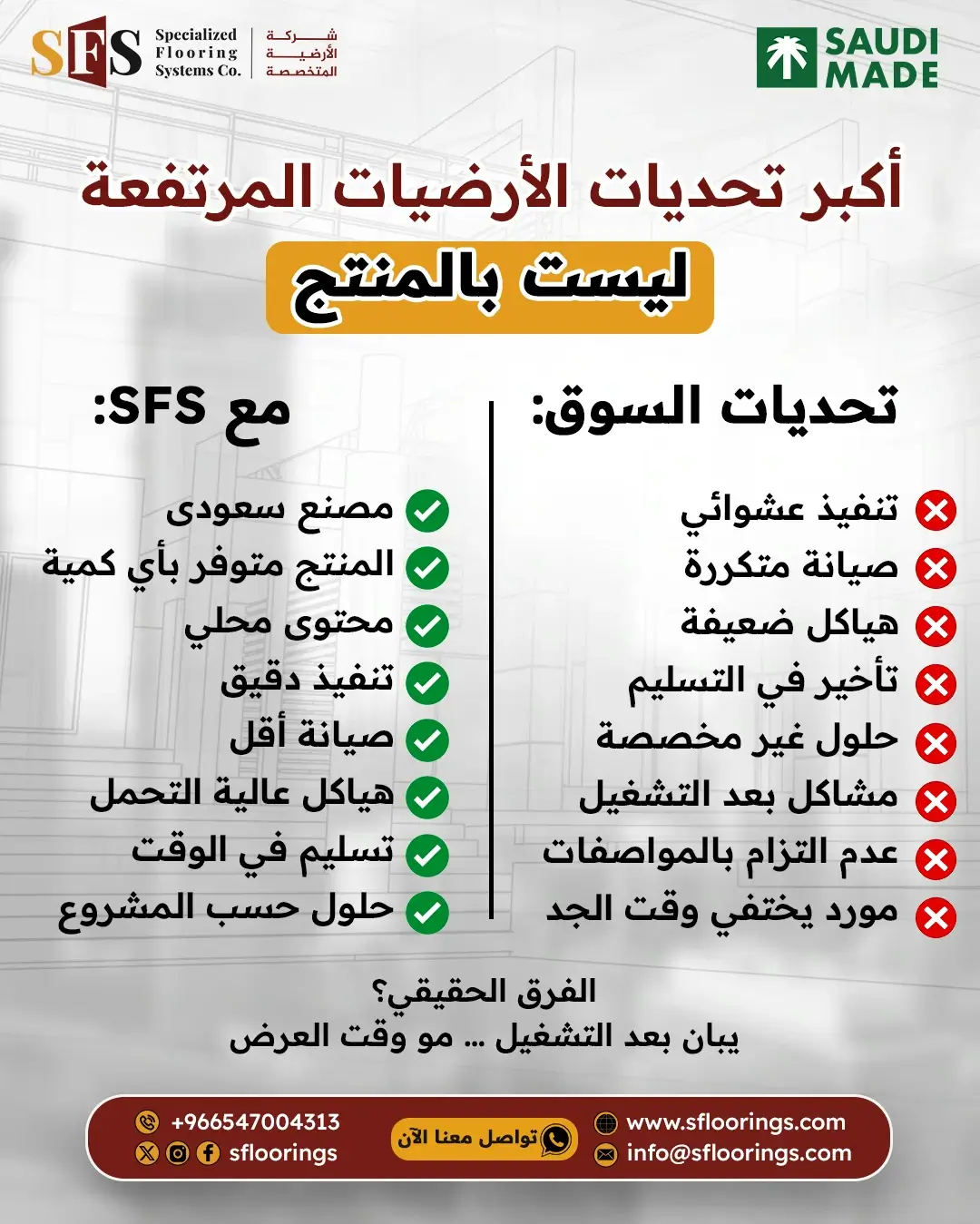
Key Problems in the Market
The raised flooring market, particularly in fast-growing regions, is plagued by recurring issues that stem from choosing the wrong partner. Understanding these problems helps you avoid them.
Poor Installation Quality
Improper installation is the number one cause of raised floor failure. Panels that are not leveled correctly rock underfoot. Pedestals that are not secured shift over time. Gaps between panels collect debris and compromise air distribution. Many suppliers subcontract installation to unqualified laborers, resulting in systems that look acceptable at handover but fail within months.
Weak Structural Integrity
Not all panels are created equal. Some suppliers offer lower-grade products with insufficient load capacity for their intended application. The result: panels that deflect under server racks, edges that crack, and a system that cannot safely support its designed weight. This is a safety hazard and an operational liability.
Supply Chain Delays
Projects run on tight schedules. A raised flooring supplier without robust inventory or local manufacturing capabilities can cause devastating delays. When panels are shipped from overseas, customs clearance, port congestion, and shipping delays can push delivery back by weeks or months.
Lack of Technical Support
After installation, questions arise. How do you add a new perforated tile? What is the correct procedure for replacing a damaged panel? Without responsive technical support, minor issues become major headaches. Many suppliers have no post-sales support structure at all.
Post-Installation Failures
The most painful problems emerge months or years after installation. Pedestals corrode in humid environments. Panel edges wear from foot traffic. Anti-static properties degrade. Without a partner committed to raised flooring support, you are left searching for solutions alone.
Hidden Costs and Scope Gaps
A low initial quote often hides missing components, inadequate quantities, or excluded services. By the time you discover the gaps, you are committed, and change orders drive the final cost far above the original budget.
What Makes a Reliable Raised Flooring Supplier?
Separating reliable partners from problematic ones requires evaluating specific capabilities. Here is what to look for.
Engineering Capability
Does the supplier employ engineers who understand structural loads, airflow dynamics, and building codes? Can they provide load calculations, plenum design recommendations, and seismic ratings? A supplier without engineering depth cannot deliver optimized solutions.
Product Quality
Ask for certifications. Reputable suppliers provide panels tested to EN 12825, ISO 14644, or equivalent standards. They offer documented load ratings (UDL and concentrated load), fire resistance classifications, and anti-static performance data. If these documents are not available, consider it a red flag.
Stock Availability and Lead Times
Can the supplier deliver standard panels within days, not months? Do they maintain local inventory? For projects in Saudi Arabia and the GCC, a raised flooring supplier with local stock eliminates supply chain risk.
Execution Experience
Request case studies or references from similar projects. A supplier who has successfully delivered data center flooring for a major bank or office raised floors for a government ministry has proven their capability. Ask about project scale, challenges encountered, and how they were resolved.
After-Sales and Support Infrastructure
What happens after the installation is complete? Is there a dedicated support team? Are spare parts available? Does the supplier offer maintenance contracts? The presence of robust raised flooring support distinguishes a transactional vendor from a long-term partner.
Why Manufacturer Capability Matters
Choosing a raised flooring manufacturer rather than a pure distributor offers decisive advantages for complex or large-scale projects.
Control Over Quality
When you work with a manufacturer, you see quality control firsthand. Raw materials are inspected. Production processes are standardized. Finished products are tested. There is no unknown middleman introducing variability.
Customization for Specific Requirements
Every project has unique needs. A data center may require higher load ratings. An office may need specific acoustic properties. A laboratory demands anti-static surfaces. A manufacturer can modify panel cores, adjust dimensions, or engineer special finishes. A distributor can only sell what they have in stock.
Faster Delivery and Supply Chain Agility
Local manufacturing dramatically reduces lead times. When a raised flooring manufacturer operates in your region, they are not subject to international shipping delays, port congestion, or customs clearance. They can respond to urgent orders and last-minute changes.
Cost Efficiency Without Quality Compromise
By eliminating intermediary markups, manufacturers can offer competitive pricing while maintaining quality. You pay for the product, not for a distributor’s profit margin layered on top.
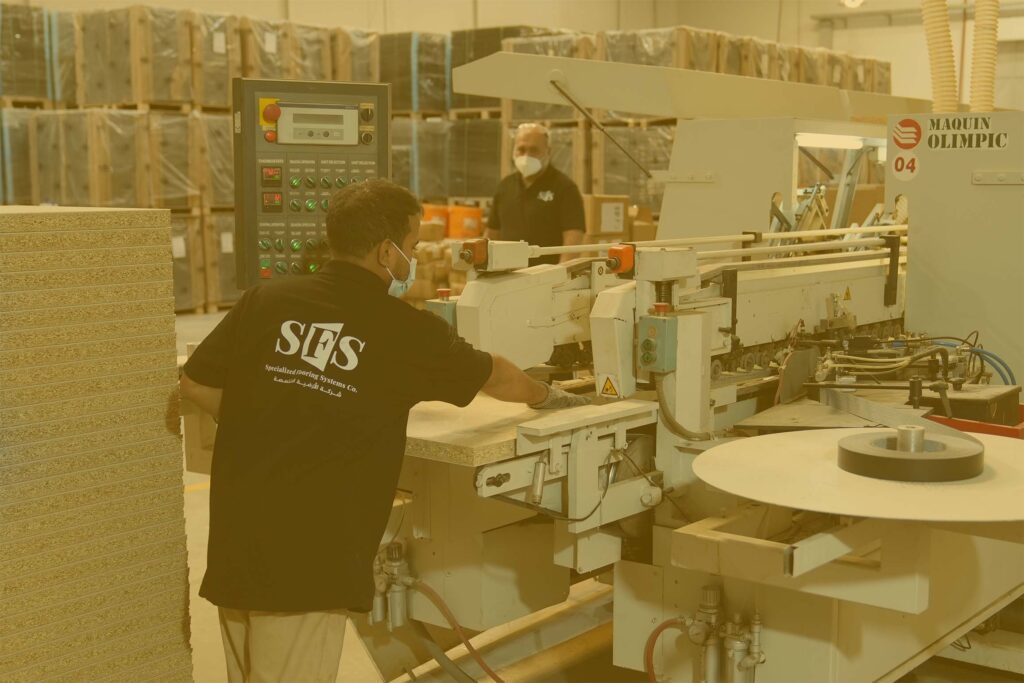
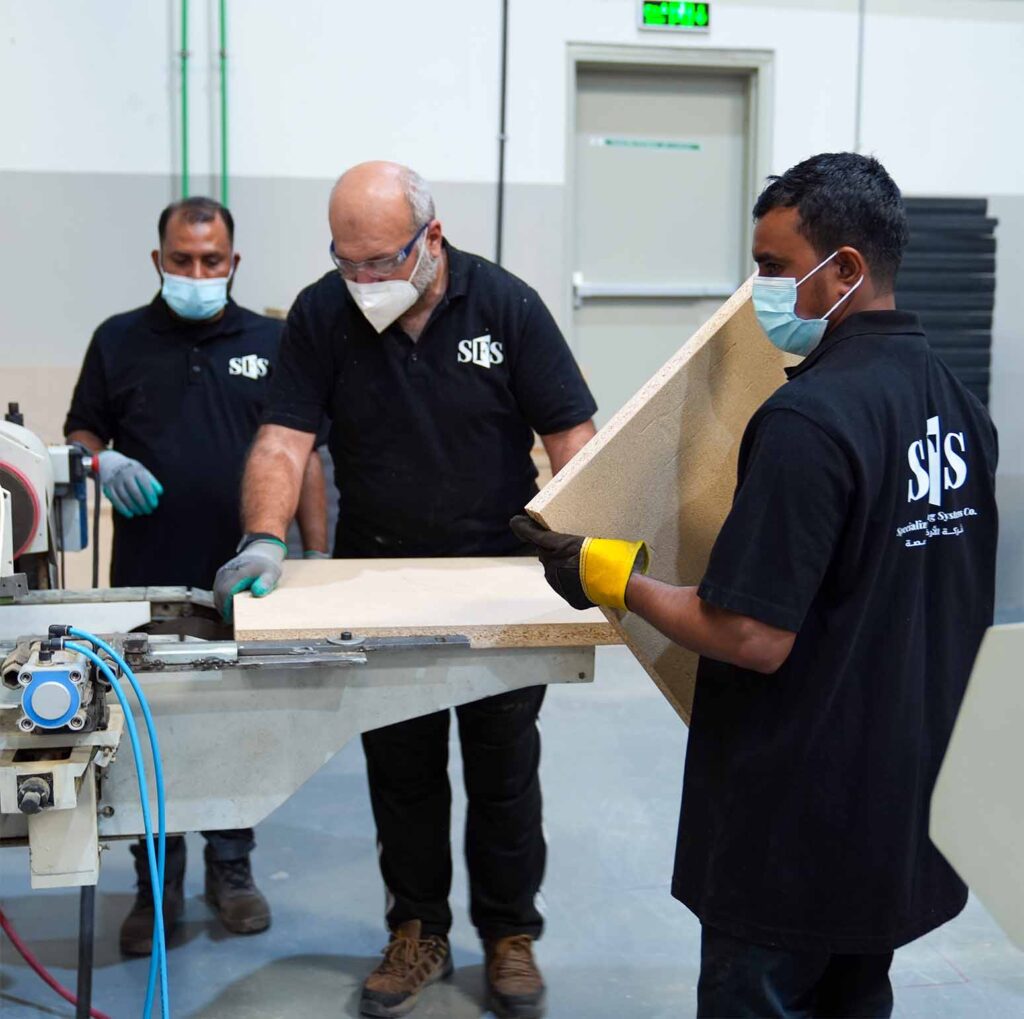
SFS, as a raised flooring manufacturer with advanced local production facilities, embodies these advantages. Every panel, pedestal, and stringer is produced under strict quality controls, engineered for the Gulf’s specific environmental conditions, and available with lead times that keep projects on schedule.
The Importance of Raised Flooring Support
Raised flooring support is often overlooked during procurement, yet it determines the system’s performance over its entire lifespan. A raised floor is not a “fit and forget” product. It requires periodic inspection, occasional adjustment, and, over time, component replacement.
Maintenance Requirements
Even the highest-quality systems benefit from regular maintenance. Pedestals should be checked for tightness. Panels should be inspected for edge wear or surface damage. Airflow pathways should be verified for obstructions. A supplier who provides maintenance guidance and service contracts ensures your system continues performing optimally.
Troubleshooting and Repairs
When issues arise—a rocking panel, a stuck tile, a damaged edge—you need answers fast. A partner committed to raised flooring support provides remote troubleshooting, on-site inspection, and rapid access to replacement components.
Spare Parts Availability
Panels get damaged. Pedestals corrode. Stringers bend. Without access to compatible spare parts, even minor damage can compromise the entire system. A responsible raised flooring supplier maintains inventory of common spare parts and can supply them quickly.
Long-Term Performance Guarantee
Support is not just about fixing problems; it is about preventing them. Proactive support—regular inspections, performance monitoring, and preventive maintenance—extends the life of your raised floor from 15 years to 25 years or more.
Technical Breakdown of Raised Flooring Systems
To make an informed decision, you need a basic understanding of the components that comprise a raised flooring system.
Raised Floor Panels
Panels are the walkable surface. They consist of a core material (cementitious, calcium sulphate, woodcore, or steel) encased in a protective skin. Panel selection determines load capacity, fire resistance, and dimensional stability. Standard size is 600mm x 600mm, but custom sizes are available.
Floor Pedestals
Pedestals are adjustable steel supports that elevate panels above the subfloor. They consist of a base plate, a threaded central stem for height adjustment, and a head that supports panel corners. Pedestal height determines plenum depth, typically ranging from 150mm to 1200mm.
Stringers
Stringers are horizontal braces connecting adjacent pedestal heads. They add lateral stability, increase load distribution, and prevent the grid from shifting. Stringers are particularly important in seismic zones or areas with heavy rolling loads.
Airflow Design Components
Perforated panels allow conditioned air to flow from the plenum into the occupied space. Grated panels offer maximum airflow for high-density cooling applications. Air dams and sealing gaskets prevent air leakage, ensuring efficient distribution.
Load Capacity Ratings
-
Uniform Distributed Load (UDL): Weight spread evenly across the panel (people, furniture). Typical commercial UDL: 1,200 – 2,000 kg/m².
-
Concentrated Load: Weight applied to a small area (server rack legs, equipment feet). Data center panels typically require 12.5 kN, 15 kN, or higher.
Finishes and Coverings
-
High-Pressure Laminate (HPL): Durable, attractive, resistant to wear.
-
Vinyl: Available in colors and patterns, easy to clean.
-
Anti-Static: Dissipates electrostatic discharge for electronics protection.
-
Carpet Tiles: Provides acoustic benefits and comfort.
Applications of Raised Flooring
Different applications demand different performance characteristics from your raised flooring supplier.
Data Centers
The most demanding application. Requires high load capacity (15 kN+), precision cooling via perforated panels, anti-static properties, and dense cable management. Failure is not an option.
Corporate Offices
Requires flexibility for reconfiguration, acoustic performance, aesthetic finishes, and easy access for technology upgrades. Panels must support standard office loads (1,200 – 1,500 kg/m² UDL).
Control Rooms
Mission-critical environments requiring zero downtime. Demands robust construction, anti-static protection, and immediate access for maintenance.
Government Buildings
Requires compliance with local regulations, high fire resistance ratings, and long-term durability. Often involves security-sensitive installations.
Smart Buildings
Integrates with building automation systems, IoT sensors, and advanced networks. Requires modular design for easy expansion and technology integration.
Healthcare Facilities
Demands seamless surfaces for infection control, anti-static properties for sensitive equipment, and accessible pathways for medical gas lines and data networks.
Cost vs Value: What Clients Often Get Wrong
The most common mistake in selecting a raised flooring supplier is focusing exclusively on initial price. This short-term thinking leads to long-term losses.
The Hidden Costs of Cheap Suppliers
-
Poor quality panels that crack or deflect, requiring replacement within years
-
Inadequate load ratings that force expensive structural modifications later
-
No support infrastructure, leaving you to solve problems alone
-
Delayed delivery that pushes back project completion, incurring penalty clauses
What True Value Looks Like
A higher initial investment from a quality raised flooring manufacturer and supplier delivers:
-
25+ year service life versus 10-15 years for inferior products
-
Energy savings of 20-40% through efficient UFAD cooling
-
Zero renovation costs for technology upgrades or layout changes
-
Immediate support when issues arise, minimizing downtime
Calculating ROI
Over a 15-year building lifecycle, the total cost of ownership for a quality raised floor is consistently lower than for a cheap alternative. The savings come from avoided renovations, reduced energy consumption, and eliminated downtime. When you evaluate proposals, ask not “What is the price?” but “What is the long-term value?”
Why SFS is a Trusted Raised Flooring Supplier
For projects across Saudi Arabia and the GCC, SFS (Specialized Flooring Systems) has established itself as the partner of choice for demanding raised flooring installations.
Local Manufacturing (Saudi Made)
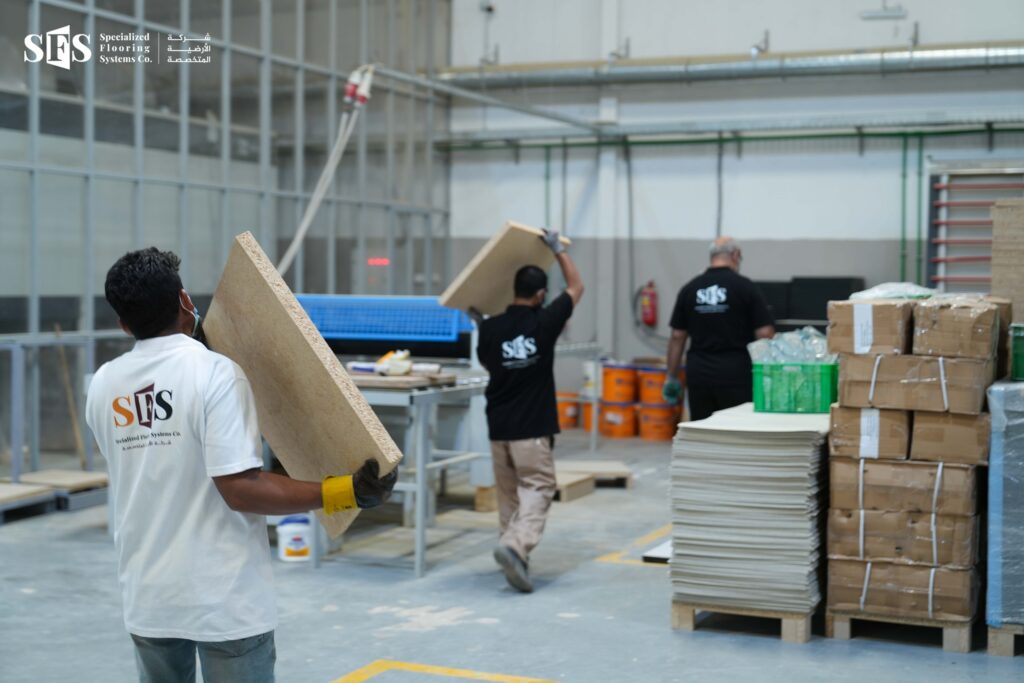
SFS operates advanced manufacturing facilities within the Kingdom. This local production capability ensures quality control, rapid customization, and lead times measured in days, not months. You are not dependent on international shipping schedules.
Strong Supply Chain
With local inventory and direct manufacturer relationships, SFS maintains consistent availability of standard panels, pedestals, stringers, and accessories. Emergency orders are fulfilled quickly.
Engineering Expertise
The SFS team includes engineers who understand structural loads, airflow dynamics, seismic requirements, and regional building codes. They provide load calculations, plenum design recommendations, and compliance documentation.
Proven Project Portfolio
SFS has successfully delivered raised flooring solutions for data centers, government ministries, financial institutions, and commercial towers across the GCC. Each project demonstrates their capability to handle complex requirements and demanding schedules.
GCC Coverage
With operations serving the entire Gulf region, SFS provides consistent quality and support whether your project is in Riyadh, Jeddah, Dammam, Dubai, or Doha.
Integrated Solution
SFS is not merely a raised flooring supplier; they are a raised flooring manufacturer and a provider of ongoing raised flooring support. This integration means one point of accountability, consistent quality, and seamless coordination from design through installation and beyond.
Case-Based Scenario: A Project Saved
Consider a real-world scenario. A major financial institution in Riyadh was upgrading its data center. The original raised flooring supplier delivered panels late. The installation was rushed. Within six months, panels began rocking, and cooling efficiency dropped by 15%. The supplier was unresponsive.
The facility manager contacted SFS. An engineering team assessed the situation. The problem: inadequate pedestal leveling and low-quality panels that had warped. SFS provided replacement panels with higher load ratings, re-leveled the entire floor, and installed air sealing to restore cooling efficiency. The data center returned to optimal performance within two weeks. The client now specifies SFS for all future projects.
How to Choose the Right Raised Flooring Partner: A Checklist
Use this checklist when evaluating potential partners:
Manufacturing Capability
-
Does the company manufacture its own products or merely distribute?
-
Are production facilities local or international?
-
Can they provide custom solutions for unique requirements?
Quality Certification
-
Are panels tested to EN 12825 or equivalent standards?
-
Are load ratings (UDL and concentrated) documented?
-
Are fire resistance and anti-static properties certified?
Local Presence
-
Does the company have local inventory?
-
Is technical support available in your region?
-
Can they respond quickly to urgent requests?
Project Experience
-
Have they completed projects similar to yours?
-
Can they provide references or case studies?
-
Do they understand your industry’s specific requirements?
Support Infrastructure
-
Is there a dedicated after-sales support team?
-
Are spare parts readily available?
-
Do they offer maintenance contracts or service agreements?
Installation Capability
-
Do they employ certified installers?
-
Do they supervise or audit installation quality?
-
Do they provide installation documentation and as-built drawings?
If a potential partner cannot check most of these boxes, consider the risk carefully.
Conclusion
Selecting the right raised flooring supplier is one of the most consequential decisions you will make for any project that depends on technology, flexibility, and long-term performance. A poor choice leads to delays, failures, hidden costs, and operational headaches. A wise choice delivers decades of reliable service, energy efficiency, and adaptability.
Remember the distinctions: a pure supplier distributes products; a raised flooring manufacturer controls quality and enables customization; and raised flooring support ensures long-term performance. The ideal partner combines all three.
For projects in Saudi Arabia and the GCC, SFS (Specialized Flooring Systems) represents that ideal. Local manufacturing, engineering expertise, proven project experience, and a commitment to ongoing support make SFS the partner you can trust for mission-critical raised flooring installations.
Do not leave your project’s success to chance. Contact SFS today to discuss your requirements. Whether you are planning a data center, an office tower, a control room, or any facility where infrastructure matters, SFS has the products, expertise, and support structure to deliver the right solution—on time, on budget, and built to last.
FAQ Section
1. What should I look for in a raised flooring supplier?
Look for manufacturing capability, quality certifications (EN 12825), local presence, proven project experience, and robust after-sales support infrastructure.
2. What is the difference between a raised flooring supplier and a raised flooring manufacturer?
A supplier distributes products from various sources. A manufacturer designs, engineers, and produces their own panels, offering greater quality control and customization.
3. Why is raised flooring support important after installation?
Support ensures long-term performance through maintenance, troubleshooting, spare parts availability, and preventive inspections, extending system life from 15 to 25+ years.
4. How do I know if a raised flooring supplier is reliable?
Check for documented quality certifications, request client references, review their project portfolio, and verify local inventory and technical support capabilities.
5. Is a local raised flooring supplier better than an international one?
Local suppliers offer faster delivery, easier communication, understanding of regional building codes, and quicker response for support and spare parts. For projects in Saudi Arabia and GCC, local presence is a significant advantage.