Selecting the wrong raised floor panels can derail an entire project. A data center manager in Riyadh once chose standard office-grade panels for a high-density server room. Within six months, the panels began deflecting under the weight of the racks. Cooling efficiency dropped by 25%. Cables became pinched and damaged. The cost of replacing the panels—plus the downtime required—was devastating. The mistake? Not understanding that raised floor panels are not a one-size-fits-all product. They are engineered components, each type designed for specific load requirements, environmental conditions, and application demands.
This guide provides a comprehensive overview of the main types of raised floor panels—encapsulated panels, steel panels, and calcium sulphate panels—along with their technical characteristics, advantages, limitations, and ideal applications. Whether you are designing a data center, an office building, a control room, or a government facility, understanding these differences is essential for making informed decisions that balance performance, durability, and cost.
What Are Raised Floor Panels?
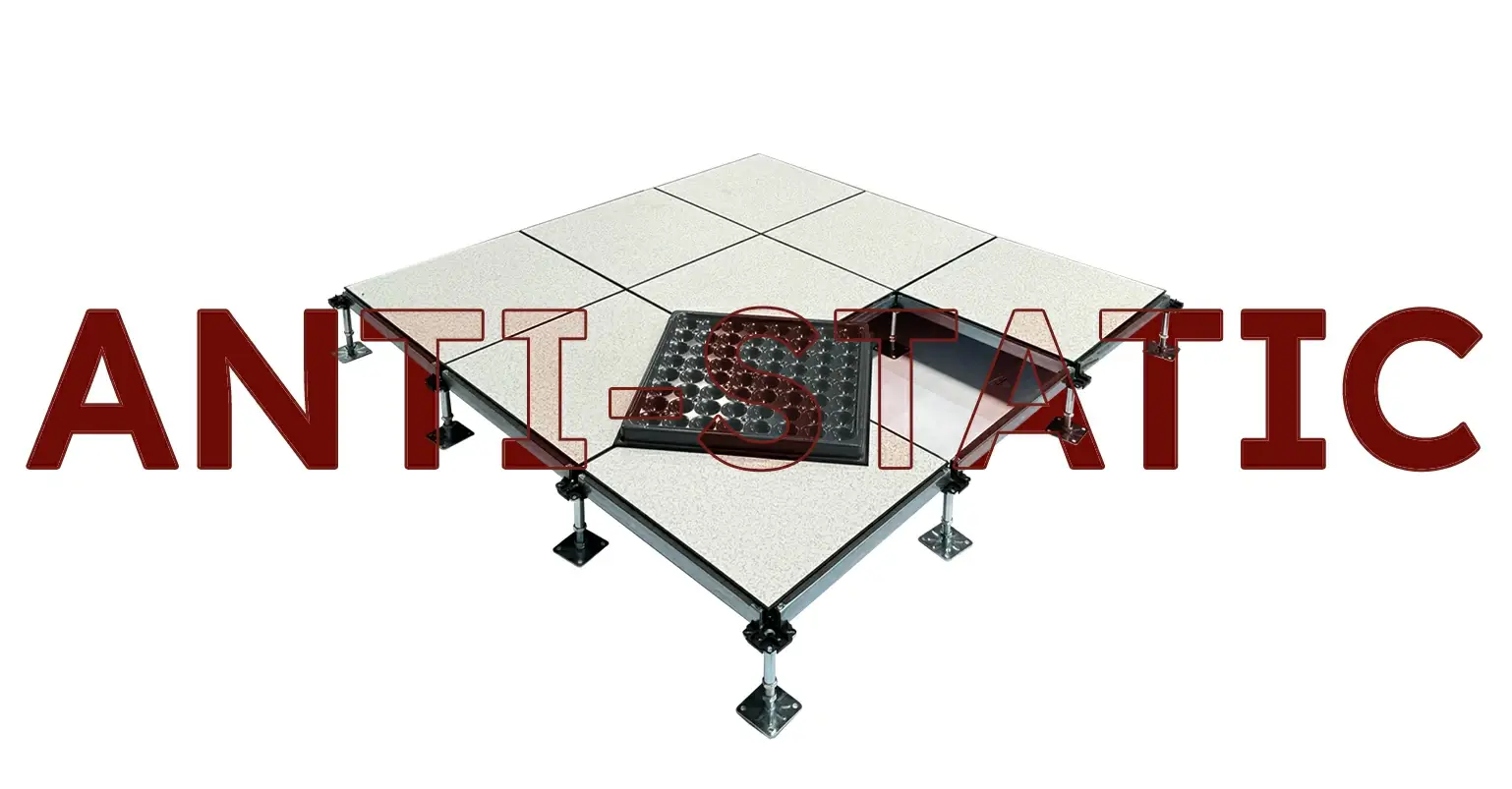
Raised floor panels are the walkable surface components of a raised access flooring system. They are modular, removable tiles typically measuring 600mm x 600mm (24″ x 24″) that rest on an adjustable grid of steel pedestals. Beneath these panels lies the plenum—a void space used to route electrical cables, data networking lines, HVAC ducts, and other building services.
A raised floor panel is not a simple slab. It is a precision-engineered component consisting of a core material encased in a protective skin (often steel), with edges reinforced for durability. The core determines the panel’s load capacity, fire resistance, thermal performance, and acoustic properties. The surface finish determines aesthetics, cleanability, and anti-static performance.
The panel is the only part of the raised flooring system that users see and interact with daily. It must support foot traffic, rolling loads (carts, maintenance equipment), concentrated loads (server racks, heavy furniture), and—in many applications—facilitate air distribution through perforations. Choosing the wrong panel compromises the entire system.
Why Choosing the Right Raised Floor Panels Matters
The consequences of selecting inappropriate raised floor panels extend far beyond the initial installation cost.
Performance Impact: A panel with insufficient load capacity will deflect under weight. This creates tripping hazards, damages cable pathways, and compromises the structural integrity of the entire floor.
Durability Consequences: Inferior core materials degrade over time. They absorb moisture, lose dimensional stability, and crack under repeated loading. What seems cost-effective at purchase becomes expensive when replacement is required within a few years.
Operational Cost Implications: In data centers, panel selection directly affects cooling efficiency. Perforated panels must be correctly specified and positioned. Solid panels must seal properly to prevent air leakage. Wrong choices increase energy bills.
Safety Risks: Panels that rock or shift create fall hazards. In anti-static environments, incorrect panel surfacing fails to dissipate electrostatic discharge, risking damage to sensitive electronics.
Long-Term Value: The right panel type, properly specified, delivers 25+ years of reliable service. The wrong type fails prematurely, requiring disruptive and expensive replacement.

Main Types of Raised Floor Panels
There are three primary categories of raised floor panels used in commercial and technical applications: encapsulated panels, steel panels, and calcium sulphate panels. Each has distinct characteristics suited to different applications.
Encapsulated Panels
Structure and Composition
Encapsulated panels consist of a lightweight core material—typically particleboard (chipboard) or a cementitious blend—fully enclosed within a formed steel casing. The steel encapsulation wraps around the top, bottom, and all four edges, creating a rigid, durable unit. The top surface is finished with High-Pressure Laminate (HPL), vinyl, or other wear-resistant materials.
The manufacturing process involves pressing the core material into a steel tray, applying adhesive, and bonding a steel top sheet under high pressure. The result is a panel that combines the structural properties of the core with the protective and conductive properties of the steel skin.
Advantages
-
Cost-Effective: Encapsulated panels are generally the most economical option. The particleboard core is less expensive than solid cementitious or calcium sulphate alternatives.
-
Versatile: Suitable for a wide range of commercial applications, including offices, retail spaces, and light technical environments.
-
Good Acoustic Performance: The particleboard core provides reasonable sound absorption, making these panels popular in office environments where noise reduction is valued.
-
Aesthetic Flexibility: Available with various surface finishes (HPL, vinyl, carpet tiles) to match interior design requirements.
-
Lightweight: Easier to handle during installation and reconfiguration compared to denser panel types.
Limitations
-
Lower Load Capacity: Encapsulated panels typically have lower concentrated load ratings compared to steel or calcium sulphate panels. They are not suitable for heavy equipment or high-density data center applications.
-
Moisture Sensitivity: The particleboard core can absorb moisture if the steel encapsulation is compromised. In humid environments or areas prone to spills, performance degrades over time.
-
Limited Fire Resistance: Particleboard is combustible. While the steel encapsulation provides some protection, encapsulated panels do not achieve the fire resistance ratings of cementitious or calcium sulphate panels.
-
Edge Vulnerability: The steel encapsulation protects edges, but repeated panel removal and replacement can wear edge seals over time.
Ideal Applications
| Application | Suitability |
|---|---|
| Corporate offices | High |
| Retail spaces | High |
| Light commercial | High |
| Schools and universities | Medium |
| Data centers | Low |
| Industrial environments | Low |
Encapsulated panels are the workhorse of commercial raised flooring. For offices, conference rooms, and spaces where loads are moderate (people, desks, chairs, light equipment), they offer an excellent balance of cost and performance.

Steel Panels
Structure and Composition
Steel panels—often referred to as steel-encased cementitious panels or all-steel panels—feature a dense core material fully encapsulated in welded steel. The most common variant uses a cementitious core (a blend of cement, sand, and other aggregates) that is poured into a formed steel tray. After curing, a steel top sheet is welded or bonded to create a completely sealed unit.
The core density provides exceptional compressive strength. The steel encapsulation adds structural rigidity, impact resistance, and protection against moisture and corrosion. The top surface can be finished with HPL, vinyl, anti-static coatings, or left as bare steel for carpet tile application.
Some steel panels use hollow steel construction or lightweight cores for applications where weight reduction is prioritized over maximum load capacity.
Advantages
-
Exceptional Load Capacity: Steel panels achieve the highest concentrated load ratings—typically 12.5 kN, 15 kN, 20 kN, or higher. They can support heavy server racks, industrial equipment, and high-density storage without deflection.
-
Superior Fire Resistance: The cementitious core is non-combustible. Steel panels achieve excellent fire resistance ratings (often 60 minutes or more), contributing to building compartmentalization and life safety.
-
Moisture Resistance: The fully welded steel encapsulation creates a water-resistant barrier. These panels perform reliably in humid environments, raised floor plenums with cooling coils, and areas where spills are possible.
-
Impact Resistance: Steel panels withstand heavy impacts, rolling loads (pallet jacks, carts), and repeated foot traffic without edge damage or surface cracking.
-
Dimensional Stability: The steel skin prevents warping, expansion, or contraction. Panels maintain flatness and fit over decades of service.
Limitations
-
Higher Cost: Steel panels are more expensive than encapsulated panels due to material costs and manufacturing complexity.
-
Heavier Weight: The dense core and steel construction make these panels heavier, requiring more effort during installation and reconfiguration.
-
Less Acoustic Damping: Steel panels reflect sound rather than absorbing it. In office environments, additional acoustic treatments may be required.
Ideal Applications
| Application | Suitability |
|---|---|
| Data centers | Extremely High |
| Server rooms | Extremely High |
| Industrial facilities | High |
| Control rooms | High |
| Heavy equipment areas | High |
| Office environments | Low-Medium |
Steel panels are the standard for data center flooring. They provide the load capacity, fire resistance, and dimensional stability that mission-critical facilities demand. For any application involving heavy equipment or requiring maximum durability, steel panels are the correct choice.
Calcium Sulphate Panels
Structure and Composition
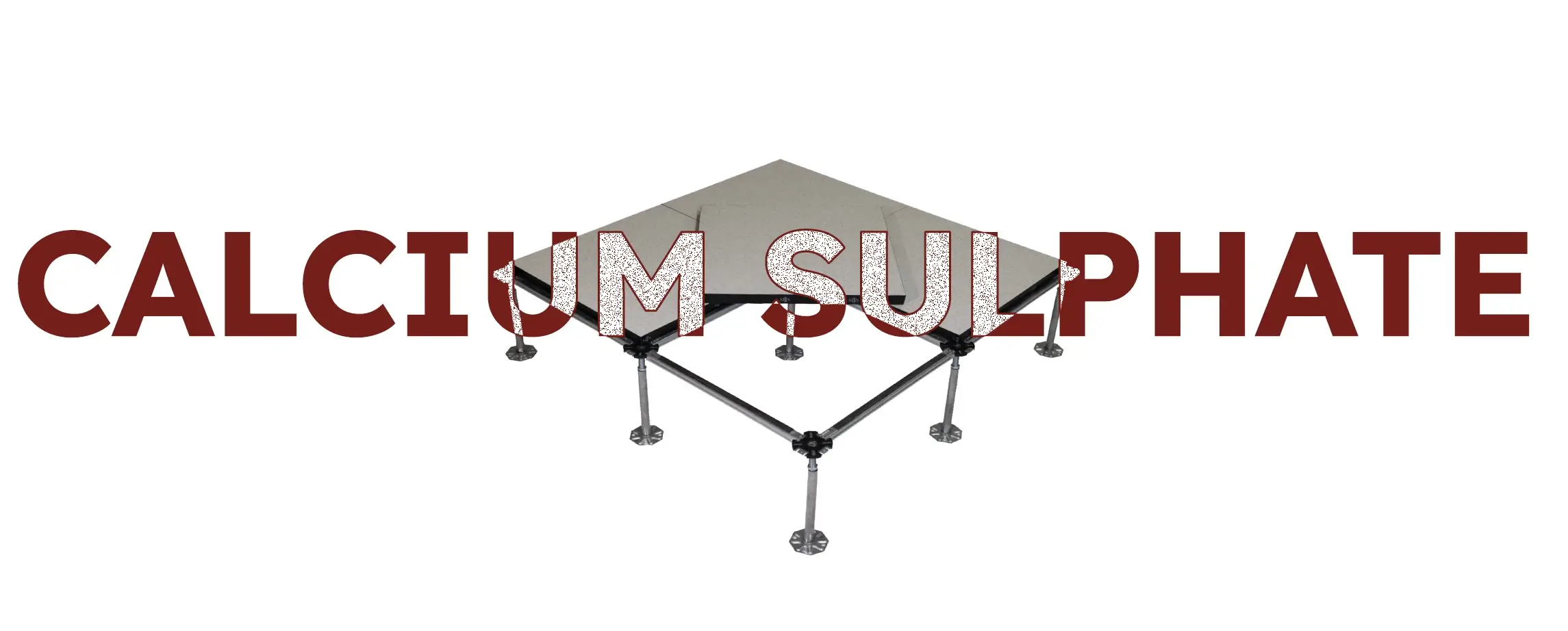
Calcium sulphate panels feature a core made from a high-density blend of calcium sulphate (gypsum) and cellulose fibers. The core is formed under extreme pressure, creating a dense, homogeneous material. It is then encapsulated between steel sheets (top and bottom) with edge banding to protect the core.
The calcium sulphate core is physically similar to cementitious materials but offers distinct performance advantages. The manufacturing process uses recycled gypsum, making these panels an environmentally preferred option.
Advantages
-
High Density and Flatness: Calcium sulphate panels achieve exceptional surface flatness—superior to both encapsulated and standard steel panels. This makes them ideal for applications requiring perfectly level floors, such as cleanrooms, laboratories, and high-end office spaces.
-
Excellent Fire Resistance: Calcium sulphate is non-combustible. These panels achieve high fire resistance ratings, often exceeding 60 minutes. They do not emit toxic smoke when exposed to fire.
-
Superior Acoustic Performance: The dense core provides excellent sound insulation. Calcium sulphate panels are often specified for office environments, call centers, and spaces where noise reduction is critical.
-
Environmental Benefits: The core is manufactured from recycled gypsum (a byproduct of industrial processes). Calcium sulphate panels contribute to green building certifications like LEED and Mostadam.
-
High Compressive Strength: While concentrated load ratings may not reach the extremes of steel panels, calcium sulphate panels offer excellent uniform load capacity suitable for most office and commercial applications.
-
Moisture Resistant: Properly encapsulated calcium sulphate panels resist moisture better than particleboard cores, though they are not recommended for wet environments.
Limitations
-
Higher Cost: Calcium sulphate panels are more expensive than encapsulated panels and comparable to premium steel panels.
-
Weight: The dense core makes these panels relatively heavy.
-
Edge Sensitivity: While edge banding protects the core, damaged edges can expose the calcium sulphate to moisture. Proper handling during installation is essential.
Ideal Applications
| Application | Suitability |
|---|---|
| Corporate headquarters | Very High |
| Call centers | Very High |
| Cleanrooms and labs | Very High |
| Government buildings | High |
| Schools and universities | High |
| Data centers (light/medium density) | Medium |
| Wet environments | Low |
Calcium sulphate panels are the premium choice for office and commercial applications where flatness, acoustics, and fire resistance are priorities. They combine the performance characteristics of cementitious panels with superior environmental and acoustic properties.
Technical Comparison Between Panel Types
| Property | Encapsulated Panels | Steel Panels | Calcium Sulphate Panels |
|---|---|---|---|
| Core Material | Particleboard / lightweight | Cementitious | Calcium sulphate (gypsum) |
| Encapsulation | Steel tray + top sheet | Fully welded steel | Steel top/bottom + edge band |
| Concentrated Load | 6 – 10 kN | 12.5 – 20+ kN | 10 – 15 kN |
| Uniform Load (UDL) | 1,000 – 1,500 kg/m² | 2,000 – 5,000+ kg/m² | 1,500 – 2,500 kg/m² |
| Fire Resistance | Moderate (combustible core) | Excellent (60+ min) | Excellent (60+ min) |
| Moisture Resistance | Low to moderate | Excellent | Good |
| Acoustic Performance | Good | Poor | Excellent |
| Surface Flatness | Good | Very Good | Exceptional |
| Weight | Light | Heavy | Medium-Heavy |
| Relative Cost | Low | High | High |
| Typical Applications | Offices, retail, light commercial | Data centers, industrial, heavy equipment | Corporate offices, call centers, cleanrooms |
How to Choose the Right Panel for Your Project
Selecting the correct raised floor panels requires evaluating several factors.
Load Requirements
Calculate both uniform loads (people, furniture, distributed weight) and concentrated loads (server rack legs, equipment feet, file cabinets). Data center applications typically require 12.5 kN concentrated load minimum. Offices may require only 6-10 kN.
Environmental Conditions
Consider humidity, temperature fluctuations, and potential for spills. Moisture-sensitive encapsulated panels are not suitable for basement installations or spaces with cooling coils in the plenum.
Fire Safety Requirements
Review building codes and insurance requirements. Some applications—particularly data centers, government facilities, and healthcare environments—mandate non-combustible panels with specific fire resistance ratings.
Acoustic Performance
For call centers, open-plan offices, and spaces where noise reduction is valued, calcium sulphate panels offer superior acoustic damping compared to steel panels.
Floor Flatness Requirements
Cleanrooms, laboratories, and precision manufacturing facilities demand exceptional flatness. Calcium sulphate panels deliver the tightest tolerances.
Budget Constraints
Encapsulated panels offer the lowest initial cost for applications where loads are light and fire resistance requirements are minimal. Steel and calcium sulphate panels require higher upfront investment but deliver longer service life and better performance.
Future Scalability
If loads may increase over time (adding more servers, heavier equipment), specify panels with capacity above current requirements. Upgrading panels later is expensive and disruptive.
Raised Floor Panels in Different Applications
Data Centers
Data centers demand steel panels with high concentrated load ratings, perforated options for airflow, and anti-static finishes. Steel panels provide the strength, fire resistance, and dimensional stability that 24/7 operations require.
Corporate Offices
Offices benefit from calcium sulphate panels for flatness and acoustic performance, or encapsulated panels for cost-sensitive projects. Surface finishes (HPL, vinyl, carpet) should match interior design requirements.
Control Rooms
Control rooms need reliable access to underfloor cabling, moderate load capacity for equipment consoles, and often anti-static properties. Steel or calcium sulphate panels both perform well.
Government Buildings
Government facilities often specify non-combustible panels with high fire resistance ratings. Steel or calcium sulphate panels meet these requirements. Local manufacturing (Saudi Made) may be required for compliance.
Smart Buildings
Smart buildings integrating IoT sensors, building automation, and dense networks benefit from any panel type, provided the raised flooring system is designed for future expansion and easy access.
Healthcare Facilities
Hospitals require seamless, easy-to-clean surfaces. Steel panels with welded construction or calcium sulphate panels with sealed edges perform well. Anti-static finishes protect sensitive medical equipment.
Common Mistakes When Selecting Raised Floor Panels
Choosing Based on Price Only
The cheapest panel rarely delivers long-term value. Low-cost encapsulated panels may fail prematurely in demanding environments. Always evaluate total cost of ownership, not just initial purchase price.
Ignoring Technical Specifications
Load ratings, fire resistance, and anti-static performance are not optional details. They are critical to safety and performance. Verify that supplier-provided specifications are certified by independent testing.
Overlooking Installation Quality
Even the best panels perform poorly if installed incorrectly. Ensure the installation team is trained and supervised. Pedestal leveling, panel locking, and perimeter sealing are as important as panel selection.
Failing to Plan for Future Needs
Today’s office may become tomorrow’s server room. Specify panels with capacity to accommodate future load increases. The incremental cost of higher-rated panels is minimal compared to replacement cost.
Selecting the Wrong Surface Finish
HPL wears differently than vinyl. Anti-static finishes must be maintained. Carpet tiles require replacement over time. Match finish to expected traffic and cleaning protocols.
Installation Impact on Panel Performance
The best raised floor panels will fail if installation is substandard. Key installation factors include:
Pedestal Leveling: Panels rest on pedestal heads. If pedestals are not precisely leveled, panels rock, creating trip hazards and uneven load distribution.
Grid Alignment: Pedestals must be positioned accurately to support panel corners. Misalignment causes gaps or interference fits.
Panel Locking: Some systems use gravity; others use mechanical locks. Ensure panels are properly seated and cannot shift under load.
Perimeter Sealing: Unsealed edges allow air leakage in UFAD systems, reducing cooling efficiency. Proper sealing gaskets and edge trim are essential.
Perforated Panel Placement: In data centers, perforated panels must be positioned within cold aisles. Incorrect placement disrupts airflow containment.
SFS provides installation supervision and technical support to ensure panels perform as designed.
Why Quality Manufacturing Matters
Not all raised floor panels are manufactured to the same standards. Quality manufacturing requires:
Premium Raw Materials: Steel gauge, core density, and finish quality directly affect performance. Inferior materials fail prematurely.
Precision Tooling: Panels must be manufactured to tight dimensional tolerances. Variations in size prevent proper fit within the grid system.
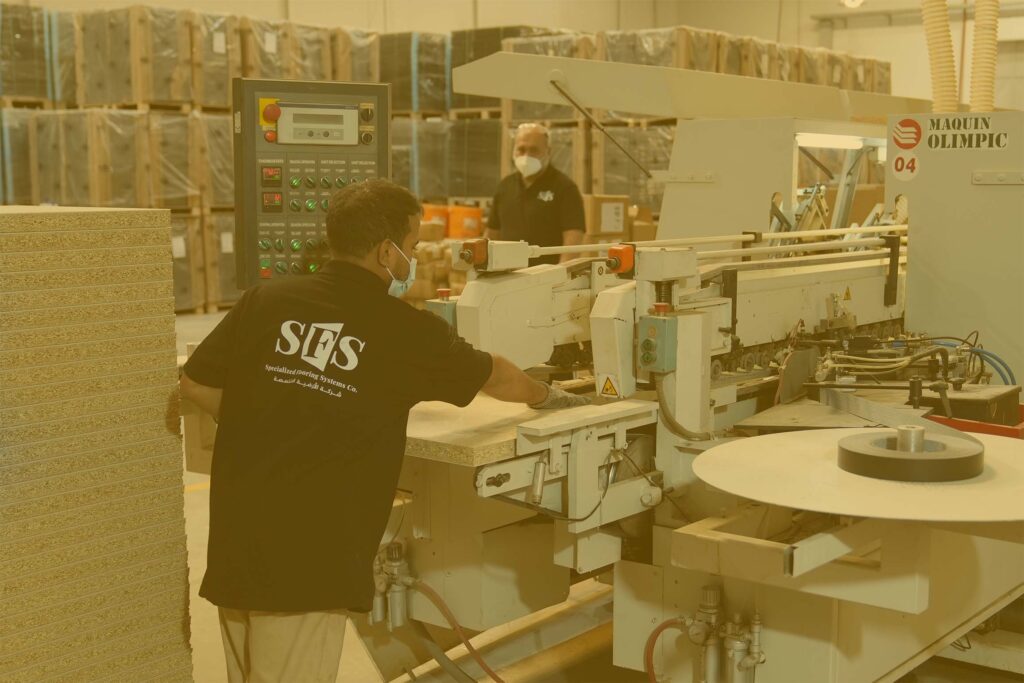
Consistent Processes: Automated production lines ensure every panel meets specifications. Manual processes introduce variability.
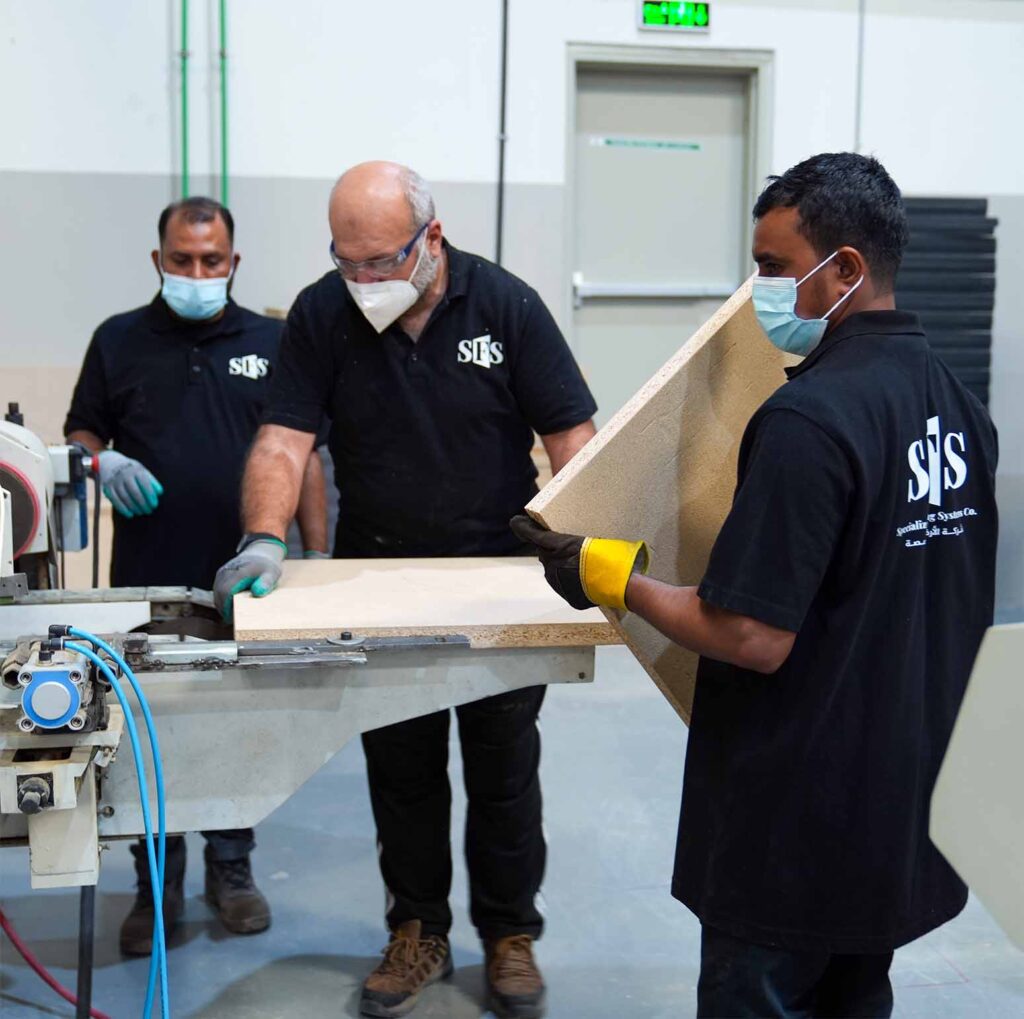
Rigorous Testing: Reputable manufacturers test panels for load capacity, fire resistance, and dimensional accuracy. Test results should be documented and available to clients.
SFS operates advanced manufacturing facilities producing panels that meet international standards (EN 12825, ISO 14644) and regional requirements.
Why SFS is a Trusted Provider of Raised Floor Panels
SFS (Specialized Flooring Systems) has established itself as a leading provider of raised floor panels in Saudi Arabia and the GCC. The company combines local manufacturing, engineering expertise, and project experience to deliver solutions tailored to regional requirements.
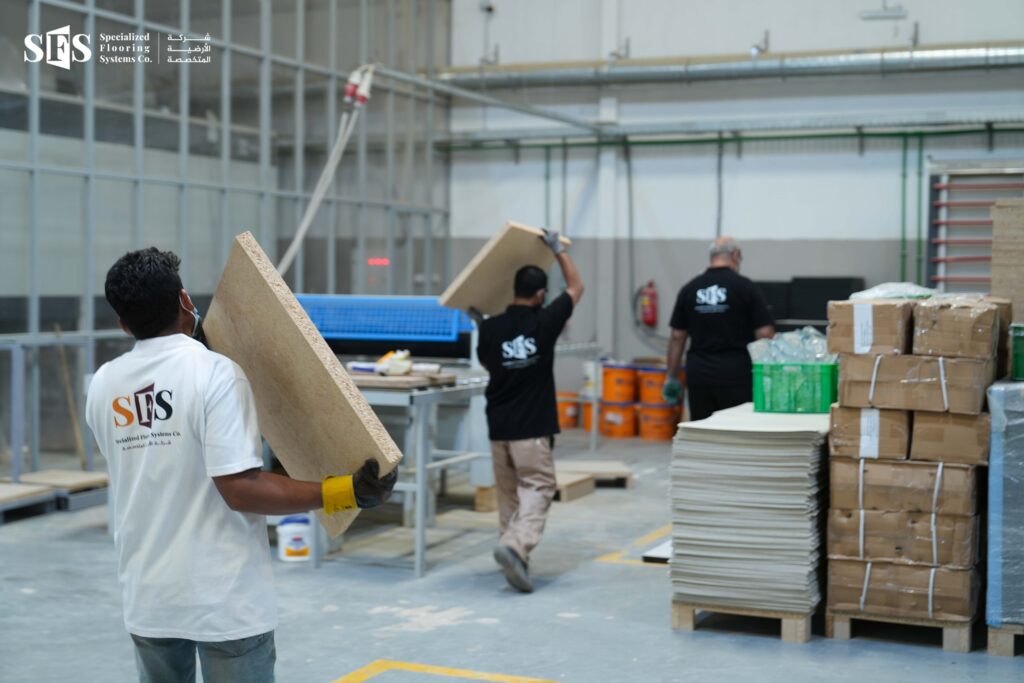
Local Manufacturing: SFS produces panels in Saudi Arabia, ensuring fast delivery, supply chain reliability, and alignment with Vision 2030 local content goals.
Engineering Support: SFS engineers assist with load calculations, panel selection, and system design. They understand the specific demands of data centers, government facilities, and commercial projects in the Gulf region.
Quality Assurance: Every panel is tested before leaving the factory. Load capacity, fire resistance, and dimensional accuracy are verified.
Comprehensive Product Range: SFS manufactures encapsulated panels, steel panels, and calcium sulphate panels, serving applications from offices to hyperscale data centers.
Installation Support: SFS provides technical support and installation supervision to ensure systems perform as designed.
Case-Based Scenario: Data Center Panel Upgrade
A financial institution in Jeddah operated a data center with encapsulated panels originally specified for an office environment. As server density increased, the panels began deflecting under the weight of new racks. Maintenance technicians reported rocking panels. Cooling efficiency had dropped by 20%.
SFS was called to assess the situation. Engineers calculated current and projected load requirements. The encapsulated panels were rated for 8 kN concentrated load. Actual rack loads exceeded 12 kN.
The solution: replace all panels with steel panels rated for 15 kN concentrated load. Perforated panels were added to cold aisles. Air sealing gaskets were installed to prevent leakage.
The result: deflection eliminated. Cooling efficiency restored. The data center now has capacity for future expansion without further panel upgrades.
Checklist: Choosing the Right Raised Floor Panels
Use this checklist to guide your panel selection:
-
Determine required concentrated load (kN) based on equipment weights
-
Determine uniform load (kg/m²) based on occupancy and furniture
-
Verify fire resistance requirements (building code, insurance)
-
Assess environmental conditions (humidity, temperature, spill risk)
-
Evaluate acoustic performance needs (office vs technical space)
-
Confirm anti-static requirements for electronics protection
-
Select surface finish (HPL, vinyl, carpet, anti-static)
-
Determine perforation requirements for UFAD cooling
-
Verify manufacturer quality certifications (EN 12825, ISO)
-
Review supplier local presence and support capabilities
-
Calculate total cost of ownership, not just initial price
-
Plan for future scalability and load increases
Frequently Asked Questions (FAQ)
1. What are raised floor panels made of?
Raised floor panels are manufactured with various core materials including particleboard (encapsulated panels), cementitious blends (steel panels), and calcium sulphate (gypsum). All types are encased in steel for durability and structural integrity.
2. Which panel type is best for data centers?
Steel panels (steel-encased cementitious) are the standard for data centers. They offer the highest concentrated load ratings (12.5 – 20+ kN), excellent fire resistance, and dimensional stability required for high-density server environments.
3. What is the difference between steel panels and calcium sulphate panels?
Steel panels use a cementitious core and achieve the highest load capacities. Calcium sulphate panels offer superior flatness and acoustic performance. Both provide excellent fire resistance. Choose steel for heavy loads; choose calcium sulphate for offices where acoustics and floor flatness are priorities.
4. Are encapsulated panels suitable for heavy loads?
No. Encapsulated panels (particleboard core) have lower load capacities and are not recommended for heavy equipment, server racks, or industrial applications. They are best suited for offices, retail spaces, and light commercial environments.
5. How do I know what load capacity my project needs?
Calculate the weight of heaviest equipment (server racks, cabinets, machinery) and divide by the number of panel corners supporting that equipment. Add a safety margin (typically 25-50%). For data centers, 12.5 kN concentrated load is minimum; 15 kN or 20 kN is recommended for future expansion.
6. Do raised floor panels require special maintenance?
Regular visual inspection for damage, cleaning of surface finishes, and periodic checks of pedestal tightness are recommended. Anti-static finishes may require specific cleaning products to maintain performance. SFS provides maintenance guidance with every installation.
7. Can raised floor panels be reused if I reconfigure my space?
Yes. One of the advantages of raised flooring systems is reusability. Panels can be lifted, relocated, and reinstalled as layouts change. However, repeated handling may wear edge seals on encapsulated panels. Steel and calcium sulphate panels are more durable for frequent reconfiguration.
Conclusion
Understanding the types of raised floor panels—encapsulated panels, steel panels, and calcium sulphate panels—is essential for any project that depends on reliable, high-performance flooring infrastructure. Each type has distinct characteristics suited to specific applications. Encapsulated panels serve offices and light commercial spaces cost-effectively. Steel panels provide the strength, fire resistance, and durability that data centers and industrial environments demand. Calcium sulphate panels deliver exceptional flatness and acoustic performance for corporate headquarters and specialized facilities.
Choosing incorrectly leads to deflection, premature failure, cooling inefficiency, and costly replacement. Choosing correctly delivers 25+ years of reliable service, operational efficiency, and adaptability for future needs.
For projects in Saudi Arabia and the GCC, SFS provides the expertise, manufacturing capability, and product range to guide you to the right decision. Local manufacturing ensures fast delivery. Engineering support ensures proper specification. Quality assurance guarantees performance.
Do not leave your project’s foundation to chance. Contact SFS today for expert guidance on selecting the right raised floor panels for your application.