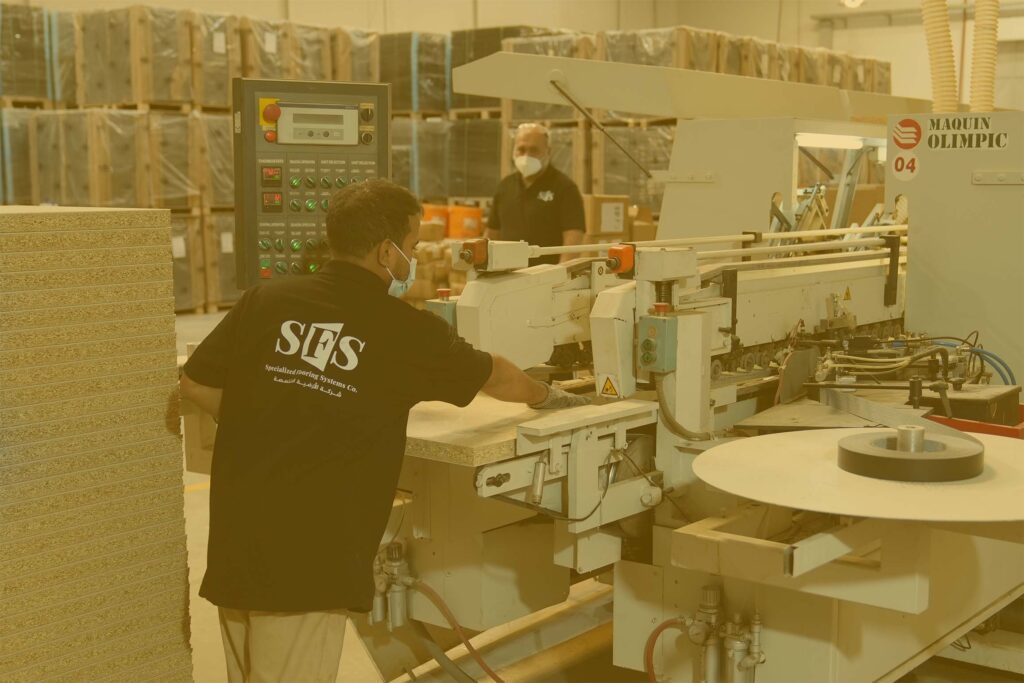
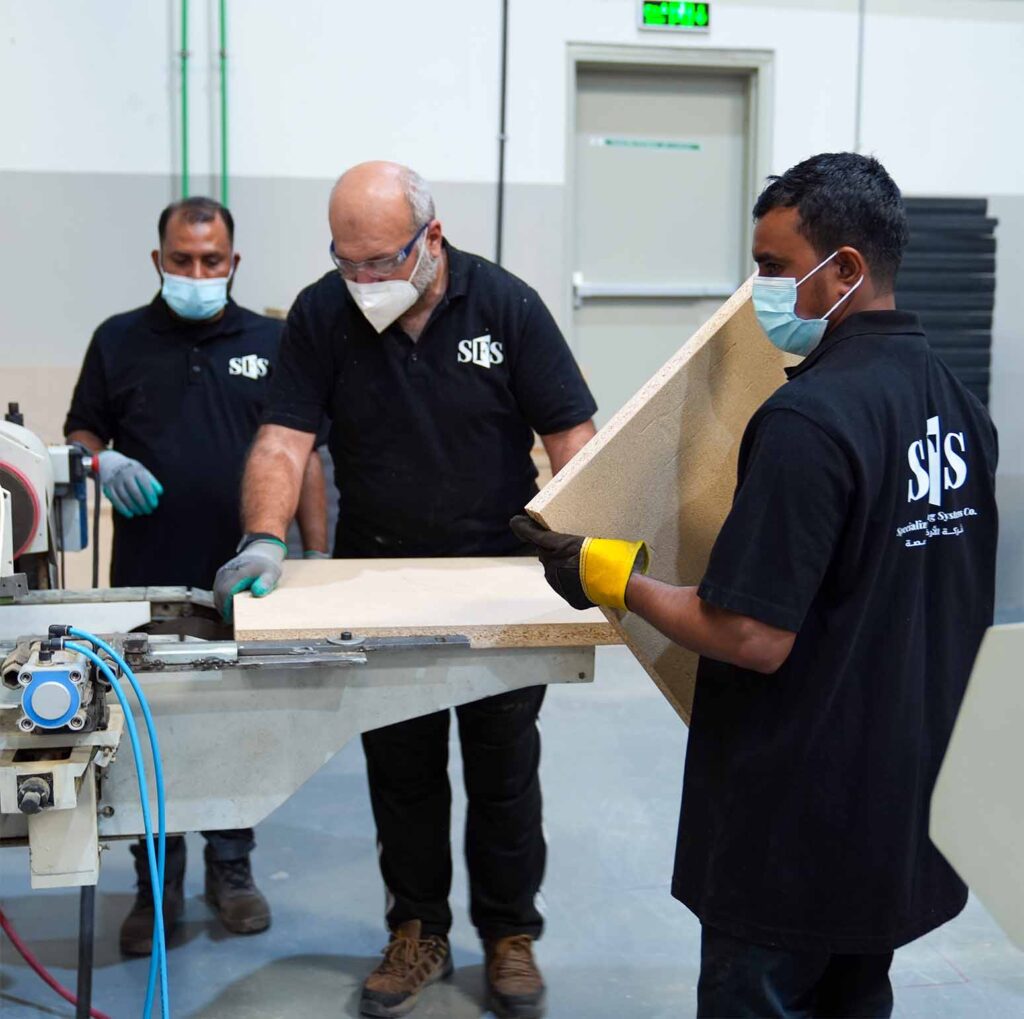
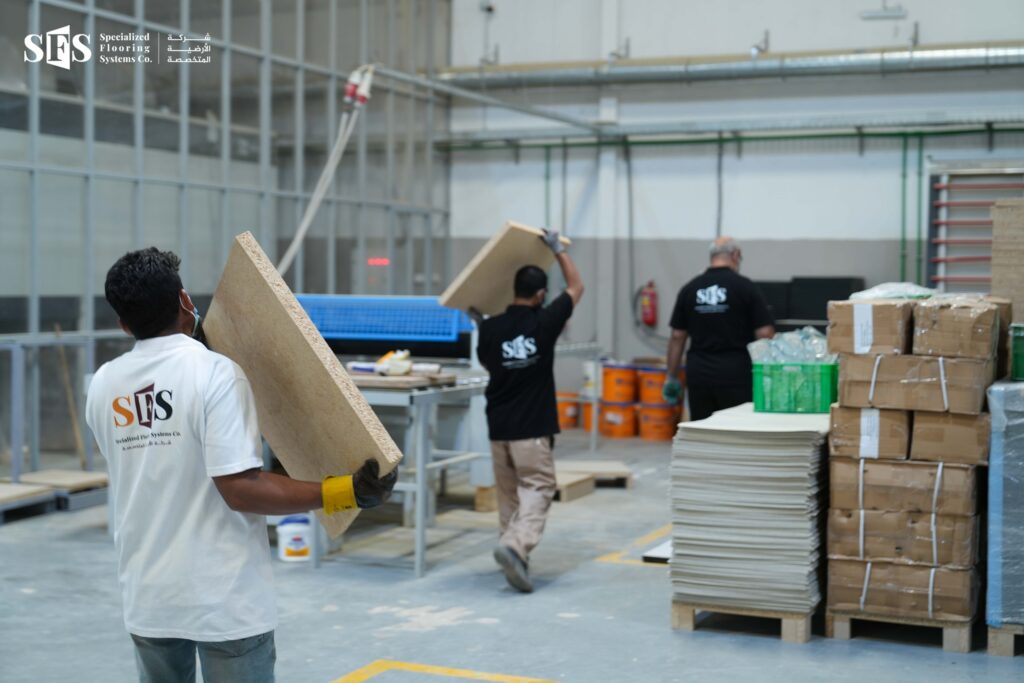
In modern construction, the raised floor has evolved from a niche product into a fundamental building infrastructure system. Whether in a data center, smart office, or government facility, a professionally specified raised floor provides the structural freedom, cable management capacity, and airflow control that conventional flooring simply cannot offer.
But what are raised floors? They are modular, elevated flooring systems supported by adjustable pedestals above the structural slab, creating a hidden service cavity. For architects, MEP engineers, and facility managers, understanding raised floor technology is no longer optional—it is essential for delivering flexible, future-ready buildings. This guide, published by SFS (Specialized Flooring Systems Co.) , provides a complete technical overview of raised floors, from core components to selection criteria, helping you identify the best raised floors for mission-critical and commercial projects.
What Is a Raised Floor?
A Simple Definition of Raised Floors
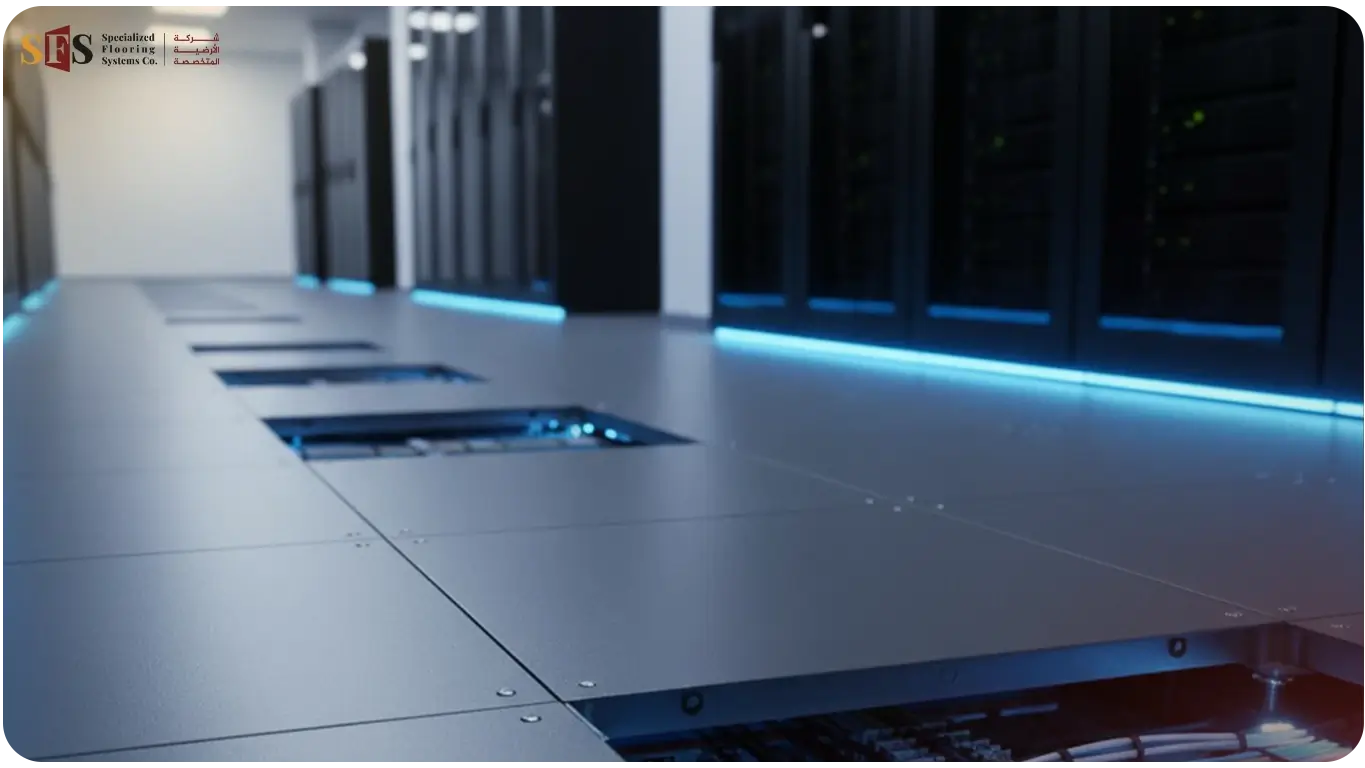
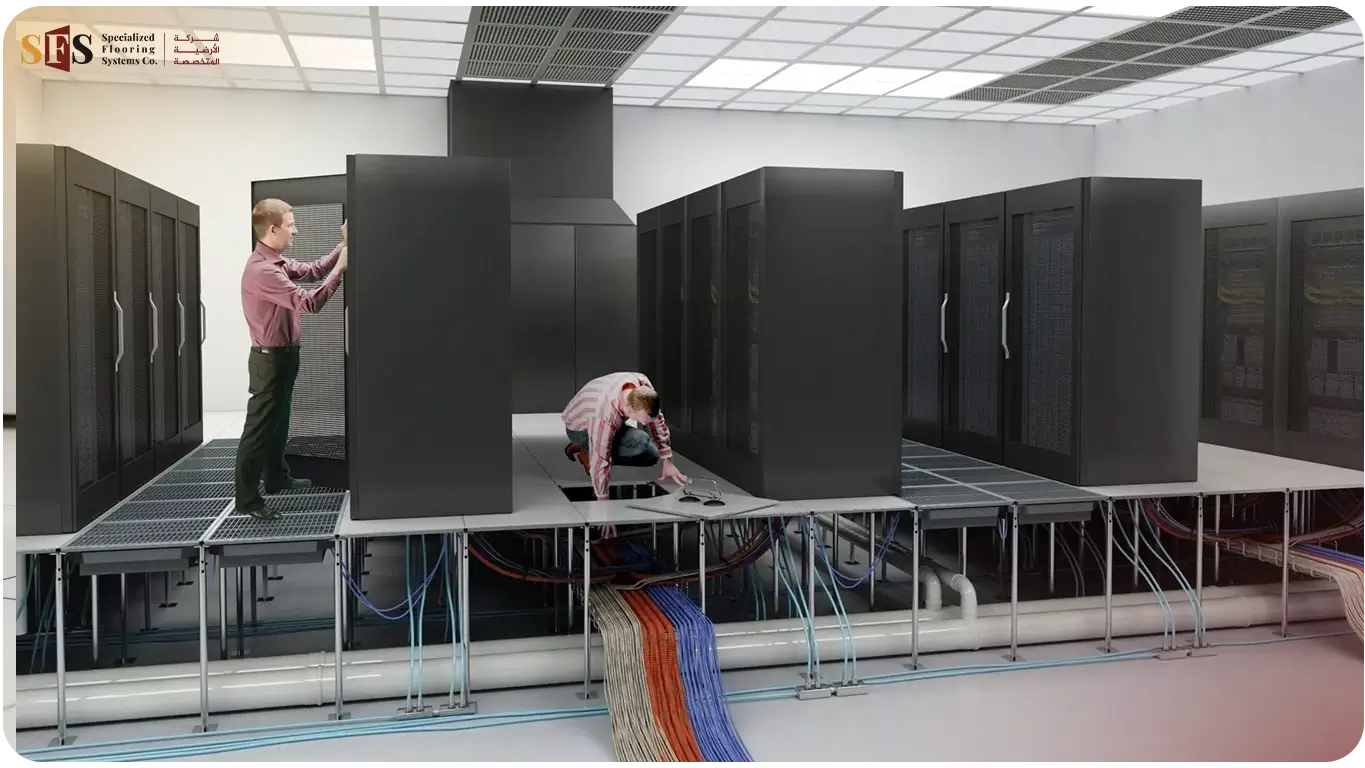
A raised floor (also called raised access flooring) is an elevated structural flooring system where removable panels are supported by adjustable pedestals above the building’s original concrete slab. The resulting cavity—typically ranging from 75mm to over 1,500mm in depth—is used to route electrical and data cabling, distribute conditioned air, and provide on-demand access to underfloor services. Unlike conventional flooring, a raised floor is designed to be modified, accessed, and reconfigured repeatedly without demolition or disruption.
How a Raised Floor System Works
The engineering behind a raised floor is precise but straightforward. Adjustable steel or aluminum pedestals are anchored to the subfloor. These pedestals support high-density core panels—typically cementitious, steel-encased, or wood-core. Panels rest on pedestal heads, often with mechanical locking or gravity hold-down.
When stringers (horizontal bracing) are added, the system gains lateral stability against seismic forces and rolling loads. The result is a perfectly level walking surface where any panel can be lifted using a suction lifter or simple hand tool. Cables, pipes, or cooling lines run freely below. This means a workstation, server rack, or partition can be moved without trenching, core drilling, or patching.
Why Raised Floors Are More Than Just Elevated Panels
A raised floor is not merely a hollow platform. It is an integrated infrastructure solution. The underfloor cavity functions as a service distribution zone, a pressurized air plenum, and a future-proofing reserve. When designed correctly, a raised floor reduces churn costs, improves energy efficiency, and extends building life. For organizations that anticipate growth, technology upgrades, or layout changes, a raised floor is a strategic asset—not just a flooring choice.
Why Raised Floor Systems Matter in Modern Buildings
The Shift Toward Smarter Building Infrastructure
Buildings are no longer passive enclosures. They are active ecosystems of power, data, sensors, and HVAC. Traditional in-slab conduit or overhead cable trays create fixed pathways that quickly become obsolete. Raised floor systems decouple the building’s structure from its services. When a company adds fiber optic lines, upgrades cooling, or reconfigures a trading floor, the raised floor adapts instantly. This shift toward intelligent infrastructure is why raised floors are now standard in Class A offices, data centers, and technical facilities.
Why Flexibility and Accessibility Matter
Commercial spaces reconfigure 30–40% of their layout every two years. Without a raised floor, each change requires electricians, flooring contractors, and often drywall repair—producing dust, noise, and downtime. With raised access flooring, a two-person team can lift panels, reroute cables, and restore the floor in hours. Accessibility is equally critical. Underfloor leaks, faulty wiring, or overheating components become immediately addressable. You do not break concrete. You simply lift a panel and solve the problem.
Why Static Flooring No Longer Meets Modern Demands
Slab-on-grade or glued-down flooring systems are static. Once installed, they resist change. Every new cable requires surface raceways or overhead trays—both visually intrusive and functionally limiting. In contrast, a raised floor embraces change. It is designed for churn. For any organization that expects growth, technology refreshes, or team restructuring, static flooring becomes a liability. Raised floors are the infrastructure response to dynamic building use.
Main Components of a Raised Floor
Raised Floor Panels
Panels are the visible surface of any raised floor. Standard size is 600mm x 600mm (2ft x 2ft). Core types vary by application:
-
Cementitious (calcium sulfate) – High density, excellent acoustic damping, common in commercial offices.
-
Steel-encased (hollow or filled) – Maximum strength, fire resistance, and grounding capability for data centers.
-
Aluminum – Lightweight, corrosion-resistant, ideal for cleanrooms or exterior applications.
-
Wood-core (particleboard) – Economical, suitable for low-traffic areas with minimal moisture exposure.
Each panel includes a factory-bonded finish (HPL, vinyl, carpet tile, or anti-static) on the top surface. Edges may feature conductive or gasketed seals for air distribution.
Floor Pedestals
Pedestals are the vertical supports of any raised floor system. A standard pedestal includes a steel base plate, a threaded rod or telescoping tube, and a head that accepts the panel corner. Height adjustability ranges from 75mm to over 1,500mm. Locking rings secure the chosen height. For seismic zones, pedestals can be bolted or adhesive-anchored. For data center cold aisles, pedestals with integrated diffusers direct airflow precisely where needed.
Stringers and Structural Support
Stringers are horizontal channels that clip or bolt between pedestals. While not always required for compression loads, stringers provide lateral stability against seismic events, rolling loads (forklifts, server carts), and panel edge deflection. In high-traffic commercial interiors, stringers dramatically improve the long-term durability of raised floors.
Surface Finishes and Coverings
The top surface of a raised floor must match the building’s operational requirements:
-
High-pressure laminate (HPL) – Durable, stain-resistant, standard for general offices.
-
Anti-static (conductive) vinyl – Dissipates static charges for server rooms and electronics manufacturing.
-
Carpet tiles – Acoustic absorption and comfort, easily replaceable.
-
Natural stone or porcelain – Aesthetic premium finishes for executive areas (requires thicker panels).
-
Bare steel (painted) – Industrial applications where additional floor covering is added on-site.
Optional Performance Enhancements
Advanced raised floor systems can include:
-
Gasketed panel edges – For pressurized air plenums (data centers, UFAD offices).
-
Conductive coatings – For electrostatic discharge (ESD) control.
-
Seismic clips – For earthquake-prone regions.
-
Integrated cable management – Underfloor baskets or dedicated cable channels.
Key Benefits of Raised Floor Systems
Better Cable Management
Underfloor cabling eliminates overhead ladder racks, junction boxes, and visible wire bundles. Power, data, AV, and security lines run independently in dedicated zones. Because the raised floor cavity is open and accessible, adding a new workstation means simply routing a new cable—no conduit bending, no firestop breaches, no ceiling access challenges.
Improved Airflow and Ventilation
In data centers and server rooms, raised floors function as pressurized supply plenums. Computer room air conditioning (CRAC) units push cold air into the underfloor cavity. Perforated tiles direct this air precisely where needed—typically into server cold aisles. This strategy reduces fan energy by 20–30% compared to overhead cooling. In offices, underfloor air distribution (UFAD) improves indoor air quality and thermal comfort.
Easier Maintenance and Access to Services
When a cable fails, a pipe leaks, or a sensor needs replacement, raised floors offer instant access. There is no drywall demolition, no core drilling, and no carpet cutting. Maintenance teams can troubleshoot underfloor issues during lunch breaks without disrupting adjacent workstations. For mission-critical facilities, this translates directly to higher uptime and lower mean time to repair (MTTR).
Greater Flexibility for Future Changes
The best raised floors are future-proof. As technology evolves—from copper to fiber, from 120V to 400V power, from air cooling to liquid cooling—the underfloor cavity adapts. You do not rewire the building; you simply replace or reroute cables. Office layouts change overnight. Server racks are moved on casters. This flexibility delivers measurable ROI over the building’s life cycle.
Better Space Efficiency
Overhead HVAC ducts, cable trays, and sprinkler pipes consume valuable ceiling height. By moving air distribution and cabling into a raised floor plenum, designers reclaim 300–600mm of headroom. This allows taller windows, better daylighting, and a more spacious feel. Alternatively, it permits lower overall building height for the same usable volume—saving structural steel and facade costs.
Long-Term Operational Value
While initial investment in a raised floor is higher than traditional slab-on-grade, total cost of ownership is lower. Churn costs (reconfiguration expenses) drop by 70–90%. HVAC energy use decreases. Uptime improves. Over a 15–20 year horizon, raised floor systems consistently outperform traditional flooring financially.
Common Applications of Raised Floors
Data Centers
The largest market for raised floors remains data centers. Here, the underfloor cavity serves three critical functions: cable management, cold air distribution, and physical separation of power and data lines. Most enterprise and colocation data centers specify raised floors with a minimum 600mm void, perforated tiles on cold aisles, and strict anti-static properties.
Server Rooms
Even small server rooms benefit from raised access flooring. A 200mm void accommodates power whips, fiber patch cables, and underfloor cooling. When equipment changes every 18–24 months, the ability to lift panels and reconfigure cabling without electricians saves thousands of dollars annually.
Smart Offices
Modern open-plan offices use raised floors to enable free-address seating, reconfigurable teams, and plug-and-play workstations. Underfloor power and data outlets pop up anywhere. HVAC floor diffusers provide individual comfort control. When a company grows or shrinks, the raised floor changes with them—no demolition, no renovation delays.
Control Rooms
Power utilities, rail networks, air traffic control, and industrial plants require 24/7 operations. Raised floors allow control room upgrades (new consoles, larger displays, additional servers) without shutting down live systems. Cables are rerouted from below while operators work above.
Government Buildings
Secure facilities, command centers, and research labs require both high security and high adaptability. Raised floors provide hidden cable management (reducing tampering risk) while allowing rapid reconfiguration for evolving missions.
Commercial and Technical Facilities
Class A office towers, hospitals, universities, and broadcast centers increasingly specify raised floors as a competitive differentiator. Tenants pay premium rents for flexibility, fast reconfiguration, and underfloor air distribution. Buildings without raised access flooring struggle to attract tech tenants, law firms, or financial services.
How to Choose the Best Raised Floors for Your Project
Understanding the Function of the Space
Start with a clear question: What goes in the void? Power cables only? Data and fiber? Air conditioning? The depth and type of raised floor depend entirely on the volume and nature of underfloor services. For low-voltage data only, 150mm may suffice. For mixed services with cooling plenum, 400–600mm is typical. For large cables or walkable maintenance access, 900mm or more.
Evaluating Load Capacity Requirements
Raised floors are rated for rolling loads (casters, carts), concentrated loads (server feet, filing cabinets), and uniform loads (people, furniture). Key standards include:
-
CISCA (USA) – Light, medium, heavy, and extra-heavy duty.
-
EN 12825 (Europe) – Classifies load performance with specific test methods.
-
PSA MOB (UK) – Common for government and commercial specifications.
For open-plan offices, medium-duty (3–5 kN concentrated) works. For data centers with heavy racks, heavy-duty (7–12 kN) is required. Always specify a safety factor of 1.5x expected live load.
Selecting the Right Materials and Finishes
Match the panel core and surface finish to the environment:
-
Data centers – Steel-encased or cementitious with anti-static HPL or conductive vinyl.
-
Offices – Cementitious or wood-core with carpet tile or standard HPL.
-
Cleanrooms – Aluminum panels with seamless welded vinyl for non-particle shedding.
-
Wet areas – Do not use standard raised floors. Specify stainless steel pedestals and sealed cementitious panels with waterproof finishes.
Matching Technical Performance to Project Demands
Beyond loads, consider:
-
Fire rating – Class A or Class 1 in the US; Euroclass Bfl-s1 or higher in Europe.
-
Seismic certification – Essential in earthquake zones.
-
Electrostatic discharge (ESD) – Conductive or dissipative ratings for electronics handling.
-
Air leakage – Gasketed panels for pressurized plenums (data centers, UFAD offices).
Why Supplier and Installation Quality Matter
Even the best components fail with poor installation. Level tolerance should be ±1mm per meter. Pedestal bases must be fully bonded to the subfloor. Panels should sit flush with no rocking. Working with an experienced specialist like SFS ensures certified installation, system compatibility, and long-term performance.
Raised Floor vs Traditional Flooring
Structural Differences
Traditional flooring is monolithic: concrete slab → adhesive → finished surface (tile, carpet, wood). Services run overhead or are cast into the slab. A raised floor is completely decoupled: structural slab → pedestals → air gap → panels → finish. This gap transforms how services are delivered and modified.
Operational Differences
With traditional flooring, any change to power or data requires an electrician, drywall repair, repainting, and often asbestos or hazardous material concerns. With a raised floor, a facility manager with basic tools reconfigures services in minutes. Traditional flooring offers zero underfloor air distribution capability. Raised floors enable highly efficient underfloor air conditioning.
Maintenance and Expansion Advantages
Traditional flooring resists change. Adding a new power drop means surface raceways or core drilling—both disruptive. A raised floor welcomes change. Lift a panel, add a cable, replace the panel. Expansion is equally straightforward. Need more cooling capacity? Add perforated tiles. Need more data ports? Route new fiber below.
Which System Offers Better Long-Term Value?
| Factor | Traditional Flooring | Raised Floor |
|---|---|---|
| First cost | Lower | Higher (2–4x) |
| Churn cost per move | $500–2,000 | $50–200 |
| Churn time | Days to weeks | Hours |
| HVAC energy efficiency | Baseline | 15–30% better |
| Future-proofing | Poor | Excellent |
| Lifespan | 10–20 years | 25+ years |
Over a 10-year period, a raised floor typically achieves lower total cost of ownership for any space that changes more than once.
Are Raised Floors Suitable for Every Project?
When Raised Floors Are the Ideal Choice
Raised floors excel when:
-
The space will be reconfigured frequently (offices, trading floors, labs).
-
Underfloor air distribution is desired for energy savings.
-
Cable density is high (data centers, control rooms).
-
Uptime matters (24/7 operations cannot tolerate demolition).
-
The building aims for LEED, BREEAM, or WELL certification.
When Technical Consultation Is Necessary
Not every project needs a raised floor. Low-turnover spaces (warehouses, parking garages, single-tenant retail) rarely justify the investment. Buildings with existing underfloor radiant heating or very low floor-to-floor heights (under 3.5m) may struggle to accommodate a raised void. Any project with pressurized water lines below a raised floor requires careful engineering. Always consult a raised floor specialist like SFS before specifying.
Common Mistakes to Avoid Before Specification
-
Underestimating cavity depth – Too shallow a void makes future changes impossible.
-
Ignoring seismic requirements – In earthquake zones, unbraced pedestals fail.
-
Choosing lowest-cost panels – Cheap panels sag, lip, or delaminate within years.
-
Forgetting ESD needs – In electronics environments, anti-static properties are mandatory.
-
Skipping professional installation – DIY or low-bid installation destroys performance.
What Makes the Best Raised Floors?
Performance Standards
The best raised floors comply with rigorous international standards: CISCA, EN 12825, or GB/T 36340. Look for third-party testing reports for fire, structural, and acoustic performance. Avoid uncertified generic systems—they often fail early or void building insurance.
Durability and Lifecycle Value
Durability means panel edges that resist compression (no lipping between panels), pedestals that do not corrode (zinc-plated or stainless steel), and finishes that withstand 10+ years of foot traffic and rolling loads. The best raised floors also include anti-static properties where required, and gasketing that maintains air seal after multiple panel lifts.
Installation Accuracy and Engineering Precision
Even premium components fail with poor installation. Level tolerance must be ±1mm per meter. Pedestal bases must be fully bonded. Panels must sit flush without rocking. Certified installers from the manufacturer’s approved network deliver this precision.
Manufacturer and Supplier Reliability
Choose partners with a track record of 20+ years, global project references, and local technical support. The best raised floors suppliers offer BIM models, load calculation tools, and on-site training. They also stock replacement panels and pedestals for 10+ years after installation—critical for long-term maintenance. SFS exemplifies this reliability, providing end-to-end support from specification to post-installation service.
Why a Raised Floor Is a Strategic Investment
Operational Efficiency
A professionally specified raised floor reduces daily friction. Cables are organized, accessible, and expandable. Cooling is targeted and efficient. Moves and changes take hours instead of weeks. This operational efficiency translates directly to lower facility management costs and higher employee or system uptime.
Infrastructure Readiness
Technology evolves unpredictably. Fiber replaces copper. Liquid cooling emerges. Power requirements double. A raised floor is infrastructure that says “yes” to the future. The cavity accommodates new cable types, additional cooling capacity, and revised layouts without structural changes. Buildings with raised floors remain competitive longer.
Long-Term Adaptability
Organizations change. Teams grow, shrink, or reorganize. A raised floor adapts without capital expenditure. Partitions move. Workstations reconfigure. Server racks relocate. The building does not fight change—it enables it. For owners and facility managers, this adaptability is not a luxury; it is a financial and operational imperative.
Conclusion
A raised floor is far more than an elevated walking surface. It is a strategic infrastructure system that delivers better cable management, improved airflow, easier maintenance, and exceptional long-term flexibility. Understanding what are raised floors is the first step; knowing how to select the best raised floors based on load capacity, materials, finishes, and quality standards is what separates successful projects from costly mistakes. For architects, engineers, and owners who value adaptability, energy efficiency, and low total cost of ownership, raised floors are not just an option—they are a competitive advantage. Evaluate your project’s churn rate, service requirements, and future growth. Then specify a certified raised floor system from a reliable specialist. The result will be a building that performs today and adapts effortlessly tomorrow.
For Professional Guidance on Raised Floor Systems
Selecting, specifying, and installing a raised floor requires technical expertise and practical experience. SFS (Specialized Flooring Systems Co.) provides end-to-end support—from load calculations and material selection to certified installation and long-term maintenance. Whether you are planning a data center, smart office, or government facility, working with an experienced partner reduces risk and ensures performance. Contact SFS to discuss your project requirements or request a technical consultation.
1. SEO Meta Title
Raised Floor | Complete Guide to Access Flooring Systems
(58 characters)
2. Meta Description
What is a raised floor? Learn how raised floor systems improve cable management, airflow, and flexibility. Find the best raised floors for your project.
(156 characters)
3. Suggested URL Slug
raised-floor-complete-guide
4. Suggested Internal Links
-
raised floors for data centers – Link from the “Data Centers” subsection to a dedicated article on data center cooling and raised floor specifications.
-
benefits of raised floor systems – Link from the “Key Benefits” section to a separate ROI-focused post quantifying churn cost savings.
-
raised floor components – Link from the “Main Components” section to a detailed technical diagram and parts catalog page.
-
anti-static raised flooring systems – Link from the “Surface Finishes” or “Data Centers” subsection to an ESD flooring product category page.
-
raised flooring solutions in Saudi Arabia – Link from the conclusion or regional callout to a location-specific service page for GCC projects.
5. FAQ Section
1. What is a raised floor used for?
A raised floor creates a hidden cavity for electrical cabling, data cables, HVAC airflow, and mechanical services. It allows easy reconfiguration of office layouts, data centers, and control rooms without demolition.
2. How much weight can a raised floor hold?
Typical raised floor panels support concentrated loads from 3 kN (light office) to 12 kN (heavy data center). Rolling load ratings range from 2 kN to 7 kN depending on panel construction and pedestal spacing.
3. Are raised floors expensive?
Initial costs are higher than traditional flooring—typically $15–40 per square foot installed. However, lower churn costs, energy savings, and longer building life often make raised floors more economical over 10–15 years.
4. Can raised floors be installed in existing buildings?
Yes. Raised floors can be retrofitted into most existing buildings provided there is sufficient floor-to-ceiling height (minimum 3.0m recommended). Pedestals are bonded to the existing slab with adhesive or mechanical anchors.
5. How do you maintain a raised floor?
Standard maintenance includes periodic vacuuming of the underfloor cavity during panel lifts. For data centers, underfloor cleaning robots or scheduled manual cleaning (every 2–5 years) prevents dust buildup that can block airflow.
6. Featured Snippet Opportunities
Definition-style paragraph (for “what is a raised floor?”):
*A raised floor, also known as raised access flooring, is a modular elevated flooring system supported by adjustable pedestals above a building’s structural slab. The resulting cavity (typically 75–1,500mm deep) routes cables, distributes conditioned air, and provides on-demand access to underfloor services without demolition.*
Bullet list section (for “benefits of raised floors”):
-
Better cable management – Route power, data, and AV lines without overhead trays
-
Improved airflow – Use underfloor plenum for energy-efficient cooling
-
Easier maintenance – Lift panels to access services in minutes
-
Flexibility – Reconfigure layouts without construction dust or downtime
-
Space efficiency – Reclaim ceiling height by moving HVAC below floor
Comparison-style section (for “raised floor vs traditional flooring”):
| Feature | Raised Floor | Traditional Flooring |
|---|---|---|
| Reconfiguration time | Hours | Days to weeks |
| HVAC integration | Underfloor plenum | Overhead ducts only |
| First cost | Higher | Lower |
| 10-year TCO | Lower (high-churn spaces) | Higher (high-churn spaces) |
| Accessibility | Lift panels | Cut/demo concrete |
7. Make the Right Specification Decision
Every building project has unique technical demands. A raised floor that performs perfectly in a data center may be inappropriate for a commercial office. Load capacity, cavity depth, material selection, and installation quality all influence long-term outcomes. SFS (Specialized Flooring Systems Co.) helps architects, engineers, and owners navigate these decisions with technical precision and practical experience. Before finalizing your flooring specification, consult a specialist who understands both the engineering and the real-world operation of raised access flooring. Contact SFS for a project assessment or technical proposal.