Raised floor cost in Saudi Arabia is one of the most common questions asked by project owners, consultants, and contractors planning new construction or renovation projects. With the Kingdom’s construction market expected to grow by 6.2% annually to reach SAR 232.14 billion in 2025, the demand for raised access flooring has never been higher. Data centers, commercial offices, government facilities, hospitals, and smart buildings across Riyadh, Jeddah, and Dammam all require high-quality raised flooring systems to support modern infrastructure needs.
However, understanding raised floor cost in Saudi Arabia is not as simple as looking at a price per square meter. The total raised floor price depends on multiple factors: panel material, load rating, pedestal height, surface finish, installation complexity, project size, and whether you choose local manufacturing or imported products. This comprehensive guide breaks down every factor that influences access floor cost, helping you budget accurately and make informed decisions for your project.
Whether you are planning a data center, corporate office, government building, or healthcare facility, this guide provides the technical and commercial knowledge you need to understand raised floor cost in Saudi Arabia and choose the right system for your requirements.
What Is the Average Raised Floor Cost in Saudi Arabia?
Raised floor cost in Saudi Arabia varies significantly based on project specifications, materials, load requirements, surface finishes, quantities, installation complexity, and customization needs. Industry benchmarks indicate that raised floor prices typically range from $50 to $150 per square meter for the materials alone, with complete installed systems ranging higher depending on specifications.
It is important to understand that access floor cost is not a fixed number. A basic office installation with standard encapsulated panels will cost considerably less than a Tier IV data center requiring high-load steel cementitious panels, anti-static finishes, and perforated tiles for Underfloor Air Distribution (UFAD). Similarly, a small renovation project will have different cost structures than a large-scale new construction development.
Rather than providing a single price figure that may be misleading, this guide explains every factor that influences raised floor cost in Saudi Arabia so you can develop an accurate budget for your specific project. For a precise quotation tailored to your requirements, it is always best to consult with a reputable manufacturer like Specialized Flooring Systems (SFS).
What Factors Affect Raised Floor Cost?
Understanding the factors that influence raised floor cost in Saudi Arabia is essential for accurate budgeting and avoiding unexpected expenses. Here are the key variables that determine raised floor price.
Panel Material
The core material of raised floor panels is one of the most significant cost drivers. Different materials offer different performance characteristics, and pricing reflects these differences.
Steel Cementitious Panels: These panels feature a high-density cement core fully encapsulated in welded steel. They offer the highest load capacity (12.5 – 20+ kN concentrated), excellent fire resistance (60+ minutes), superior moisture resistance, and exceptional impact resistance. Due to their superior performance and manufacturing complexity, steel cementitious panels are among the higher-cost options. They are the standard choice for data centers, server rooms, industrial facilities, and heavy equipment areas.
Calcium Sulphate Panels: Featuring a high-density gypsum core with cellulose fibers, encapsulated between steel sheets, these panels offer exceptional surface flatness, excellent fire resistance (non-combustible), superior acoustic performance, and environmental benefits (recycled gypsum). Calcium sulphate panels are priced at a premium level, comparable to high-end steel panels, and are ideal for corporate headquarters, call centers, cleanrooms, and government buildings.
Encapsulated Panels: These consist of a lightweight particleboard core enclosed in a formed steel casing. They are the most cost-effective option, suitable for offices, retail spaces, and light commercial applications with moderate loads. While encapsulated panels offer good acoustic performance and versatility, they have lower load capacity (6-10 kN concentrated) and limited fire resistance compared to other options.
Aluminum Panels: Lightweight and corrosion-resistant, aluminum panels are ideal for cleanrooms or exterior applications. They are among the most expensive options due to material costs, with prices ranging from $800–1,200/m² for specialized applications.
Load Rating
The required load capacity significantly impacts raised floor cost in Saudi Arabia. Panels with higher concentrated load ratings require denser cores, thicker steel encapsulation, and more robust manufacturing processes.
-
Light duty (3-5 kN): Suitable for general offices with minimal equipment loads. Lower cost.
-
Medium duty (6-10 kN): For offices with moderate equipment, educational facilities. Moderate cost.
-
Heavy duty (12.5+ kN): Required for data centers, server rooms, and industrial applications. Higher cost.
-
Extra heavy duty (15-20+ kN): For high-density data centers and specialized industrial environments. Premium cost.
Specifying a higher load rating than currently needed may increase initial raised floor cost, but it provides future expansion capability and avoids costly replacement later.
Panel Size and Thickness
Standard panel size is 600mm x 600mm, but custom sizes may be required for specific applications. Panel thickness typically ranges from 28mm to 40mm, with thicker panels offering higher load capacity but also higher cost. Custom sizes may require additional tooling or manufacturing adjustments, increasing raised floor price.
Pedestal Height
Pedestal height determines plenum depth, which affects both material and installation costs. Shallow plenums (150-300mm) for basic cable management use shorter pedestals and less material. Deep plenums (600-1200mm) for data centers requiring high-volume airflow use taller pedestals and more structural components. The height also affects the complexity of installation and the need for additional bracing or seismic considerations.
Surface Finish
The surface finish significantly affects both aesthetics and raised floor cost.
-
High-Pressure Laminate (HPL): Durable, attractive, and resistant to wear. Moderate cost, standard for offices.
-
PVC/Vinyl: Available in various colors and patterns. Easy to clean. Moderate cost.
-
Carpet Tiles: Provides acoustic benefits and comfort. Moderate to high cost, depending on quality.
-
Conductive Finishes: Dissipates electrostatic discharge (ESD). Essential for data centers and electronics environments. Higher cost due to specialized materials.
-
Ceramic or Stone Tiles: Premium aesthetic finish. Highest cost, requires thicker panels for support.
Project Size
Economies of scale significantly affect raised floor cost in Saudi Arabia. Larger projects generally achieve lower per-square-meter costs due to:
-
Bulk material pricing
-
Efficient logistics and shipping
-
Reduced setup and mobilization costs per unit
-
Streamlined installation processes
Smaller projects may have higher per-unit costs due to fixed setup and delivery expenses.
Installation Complexity
Installation cost is a significant component of total raised floor price. Factors that increase installation complexity and cost include:
-
Subfloor preparation: Uneven or contaminated subfloors require additional leveling or cleaning.
-
Cutting and fitting: Edge panels, curved layouts, and obstacles (columns, pipes) require more cutting and fitting time.
-
Ramps and transitions: Doorways, steps, and level changes require custom ramps and transition pieces.
-
Perforated panels: Data centers require careful placement of perforated tiles for airflow.
-
Anti-static requirements: Special handling and testing for ESD-sensitive environments.
-
Seismic considerations: Additional bracing and anchoring for earthquake-prone areas.
Project Location
Logistics and transportation costs vary across Saudi Arabia. Projects in remote locations may incur higher delivery costs. However, choosing a local manufacturer like SFS with production facilities in Riyadh can significantly reduce transportation expenses and lead times compared to imported products.
Additional Components
The complete raised floor system includes more than just panels. Pedestals, stringers, edge trim, air sealing gaskets, cable management accessories, and installation labor all contribute to total raised floor cost in Saudi Arabia. A complete system quotation should include all these components to avoid hidden costs.
Raised Floor Cost by Application
Raised floor cost in Saudi Arabia varies significantly by application. Each industry has specific requirements that influence material selection, load ratings, finishes, and installation complexity.
Data Centers
Data centers require the highest specifications and therefore command premium raised floor prices. Key requirements include:
-
Steel cementitious panels with 15-20+ kN concentrated load
-
Anti-static finishes for ESD protection
-
Perforated panels for cold aisle containment
-
Deep plenums (600-1200mm) for airflow
-
Stringers for lateral stability
-
Precision installation with laser leveling
Data center raised floor cost is typically at the higher end of the spectrum due to these demanding specifications and the critical nature of the installation.
Corporate Offices
Office applications prioritize flexibility, aesthetics, and acoustic comfort. Key requirements include:
-
Calcium sulphate panels (for flatness and acoustics) or encapsulated panels (for cost sensitivity)
-
HPL, carpet tile, or vinyl finishes
-
Moderate plenum depth (150-300mm)
-
Standard load ratings (6-10 kN)
Office raised floor cost is generally moderate, with calcium sulphate panels at the higher end and encapsulated panels providing a more economical option.
Government Buildings
Government facilities require compliance with Saudi regulations, high fire resistance, and secure infrastructure. Key requirements include:
-
Non-combustible panels (calcium sulphate or steel cementitious)
-
Fire resistance ratings of 60+ minutes
-
Compliance with Saudi Building Code
-
Local manufacturing for national content compliance
Government raised floor cost tends to be higher due to stringent compliance and security requirements.
Hospitals and Healthcare Facilities
Healthcare environments demand seamless, cleanable surfaces with infection control properties. Key requirements include:
-
Seamless vinyl finishes with welded edges
-
Anti-static properties for sensitive medical equipment
-
Accessible pathways for medical gas lines and data networks
-
Materials that withstand rigorous cleaning protocols
Healthcare raised floor cost is typically moderate to high due to specialized finish requirements.
Banks and Financial Institutions
Trading floors and server rooms require anti-static protection and zero downtime for maintenance. Key requirements include:
-
Anti-static finishes
-
Secure, accessible infrastructure
-
High load capacity for equipment
Banking raised floor cost is typically moderate to high.
Control Rooms
Mission-critical environments require robust construction and immediate access for maintenance. Key requirements include:
-
Steel or calcium sulphate panels
-
Anti-static protection
-
Zero-downtime maintenance access
Control room raised floor cost is typically high due to the critical nature of the application.
Educational Institutions
Classrooms and laboratories benefit from raised floors for technology integration. Key requirements include:
-
Moderate load capacity
-
Durable finishes
-
Flexibility for reconfiguration
Educational raised floor cost is typically moderate.
Industrial and Telecom Facilities
Industrial environments and telecom hubs require high load capacity and durable panels. Key requirements include:
-
Steel cementitious panels with 12-20+ kN load capacity
-
Durable finishes (bare steel or anti-static coatings)
-
Dense cable management
Industrial raised floor cost is typically moderate to high.
Material Comparison: Cost vs Performance
| Panel Type | Relative Cost | Load Capacity | Fire Resistance | Acoustic Performance | Ideal Applications |
|---|---|---|---|---|---|
| Steel Cementitious | High | Highest (12.5-20+ kN) | Excellent (60+ min) | Poor | Data centers, industrial, heavy equipment |
| Calcium Sulphate | High | Very High (10-15 kN) | Excellent (60+ min) | Excellent | Corporate offices, call centers, cleanrooms |
| Encapsulated | Low | Moderate (6-10 kN) | Limited (combustible) | Good | Offices, retail, light commercial |
| Aluminum | Very High | Moderate | Good | Moderate | Cleanrooms, exterior applications |
Installation Costs
Raised floor installation cost includes labor, equipment, and project management. Professional installation is essential for ensuring the system performs as designed and delivers long-term value.
What Installation Pricing Includes
A comprehensive raised floor installation quotation typically includes:
-
Site survey and assessment: Evaluating subfloor condition, levelness, and environmental factors.
-
Material handling: Delivery, storage, and distribution of panels, pedestals, and accessories.
-
Pedestal installation: Positioning, anchoring, and leveling of all pedestals.
-
Stringer installation: Connecting stringers for lateral stability (if specified).
-
Panel installation: Placing, aligning, and securing all panels.
-
Cutting and fitting: Custom cutting of edge panels and panels around obstacles.
-
Level adjustment: Fine-tuning pedestal heights for precise leveling (≤2.0mm per meter).
-
Quality inspection: Verifying levelness, panel fit, stability, and load performance.
-
Final cleaning: Removing debris and preparing the floor for use.
-
Project handover: Documentation and client acceptance.
Typical Installation Cost Factors
Installation labor typically ranges from $3 to $6 per square foot for an experienced raised flooring crew. However, this varies based on:
-
Project size: Larger projects benefit from economies of scale.
-
Installation complexity: Edge panels, obstacles, and curved layouts increase labor time.
-
Site conditions: Subfloor preparation requirements affect labor costs.
-
Location: Remote sites may incur additional travel and accommodation costs.
Installation Best Practices
To ensure a successful installation and avoid costly rework:
-
Use certified installers: Experienced raised floor contractors deliver precision and reliability.
-
Verify subfloor preparation: Ensure the subfloor is clean, dry, and level before installation begins.
-
Specify laser leveling: Professional installers use laser leveling equipment to achieve tolerances within ±1mm.
-
Conduct quality inspections: Verify levelness, panel fit, and stability at multiple points during installation.
-
Test load capacity: For heavy-load areas, perform load testing to verify compliance with specifications.
-
Document the installation: Maintain as-built drawings and test certificates for future reference.
Common Mistakes That Increase Raised Floor Costs
Avoid these costly errors when planning your raised flooring project.
Choosing Based Only on Price
The most common and most expensive mistake. Low-cost systems often use inferior materials, have lower load capacities, lack certifications, and fail prematurely. The cheapest raised floor price rarely delivers the best long-term value. Replacement costs far exceed initial savings.
Incorrect Specifications
Specifying the wrong panel material, load rating, or pedestal height leads to performance issues and premature failure. Underestimating load requirements causes deflection and damage. Overestimating adds unnecessary cost.
Underestimating Future Expansion
Specifying minimum load capacity or shallow plenum depth to save cost today makes future expansion expensive or impossible. Always specify for anticipated growth.
Poor Installation Quality
Even the best components fail with poor installation. Unlevel pedestals cause rocking panels. Improper panel locking creates gaps. Missing air seals reduce cooling efficiency. Professional installation by certified raised floor contractors is essential.
Low-Quality Materials
Inferior panel cores degrade over time, absorbing moisture, losing dimensional stability, and cracking under repeated loading. Cheap finishes wear quickly, requiring premature replacement.
Lack of Engineering Consultation
Skipping engineering consultation leads to incorrect specifications, poor airflow planning, and missed opportunities for cost optimization. Engineering expertise ensures the system performs as designed.
Ignoring Total Cost of Ownership
Focusing only on initial raised floor price ignores long-term costs: maintenance, energy consumption, downtime, and future modifications. A higher-quality system with lower operating costs delivers better lifetime value.
How to Reduce Raised Floor Project Costs Without Compromising Quality
Accurate Project Planning
Invest time in thorough planning before procurement. Define load requirements, plenum depth, finishes, and future expansion needs. Accurate specifications prevent costly changes later.
Early Engineering Coordination
Engage raised flooring specialists during the design phase. Engineering consultation ensures correct specifications, optimized airflow planning, and cost-effective solutions.
Select Appropriate Specifications
Choose specifications that match your actual requirements, not over-specified or under-specified systems. Avoid paying for unnecessary performance while ensuring adequate capacity for future needs.
Work with Experienced Manufacturers
Partner with established manufacturers like SFS who understand regional requirements and can provide engineering support. Local manufacturing reduces lead times and transportation costs.
Order Complete Systems
Order all components—panels, pedestals, stringers, accessories—from a single manufacturer. This ensures compatibility, simplifies logistics, and often achieves better pricing.
Plan for Future Expansion
Incorporate future expansion into initial specifications. Higher load ratings and deeper plenums add minimal cost upfront compared to expensive retrofits later.
Choose Local Manufacturing
Local manufacturing in Saudi Arabia offers significant cost advantages: shorter lead times, lower transportation costs, better communication, and faster technical support. Imported products incur shipping costs, customs duties, and currency fluctuation risks.
Why Local Manufacturing in Saudi Arabia Can Reduce Overall Project Costs
Choosing a local raised floor supplier with manufacturing capabilities in Saudi Arabia offers decisive cost advantages.
Shorter Lead Times
Local manufacturing eliminates international shipping delays. No customs clearance. No port congestion. Standard panels delivered within days, not months. Faster delivery reduces project financing costs and accelerates revenue generation.
Lower Transportation Costs
Importing raised flooring involves product cost, international freight, insurance, customs duties, and local transportation. Local manufacturing removes many of these layers, resulting in competitive pricing without compromising quality.
Better Communication
Time zones, language barriers, and cultural differences complicate international sourcing. Local manufacturing enables face-to-face meetings, site visits, and real-time communication. Problems solved faster. Decisions made quicker.
Faster Technical Support
Local engineering support provides immediate assistance for load calculations, plenum design, and troubleshooting. No waiting for overseas responses.
Supply Chain Stability
Global supply chains are vulnerable to disruptions. Local manufacturing insulates projects from international shipping delays, port strikes, and geopolitical tensions.
Easier Customization
Local manufacturers can adapt products to specific project requirements rapidly. Custom panel sizes, special load ratings, and unique finishes are easier to achieve with local production.
Compliance with Saudi Regulations
Local manufacturing ensures compliance with Saudi Building Code and national content requirements. This streamlines project approval and supports Vision 2030 local content goals.
Why Choose Specialized Flooring Systems (SFS)
Specialized Flooring Systems (SFS) is a leading raised floor manufacturer and supplier in Saudi Arabia, offering comprehensive solutions for commercial, technical, and industrial projects across the Kingdom and the GCC.
Saudi Manufacturing Facility
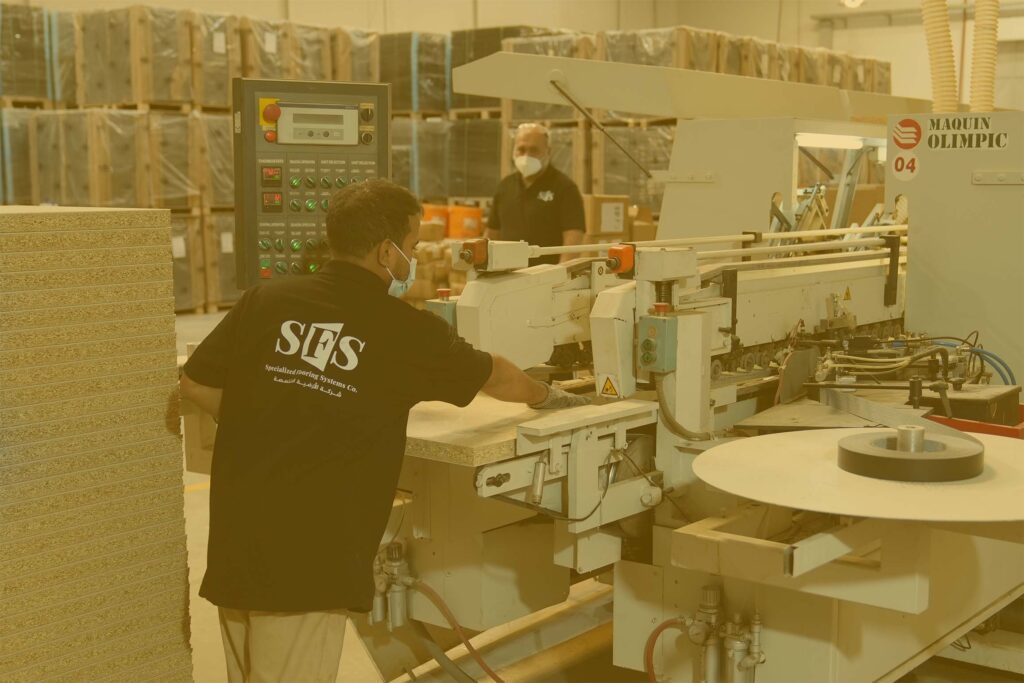
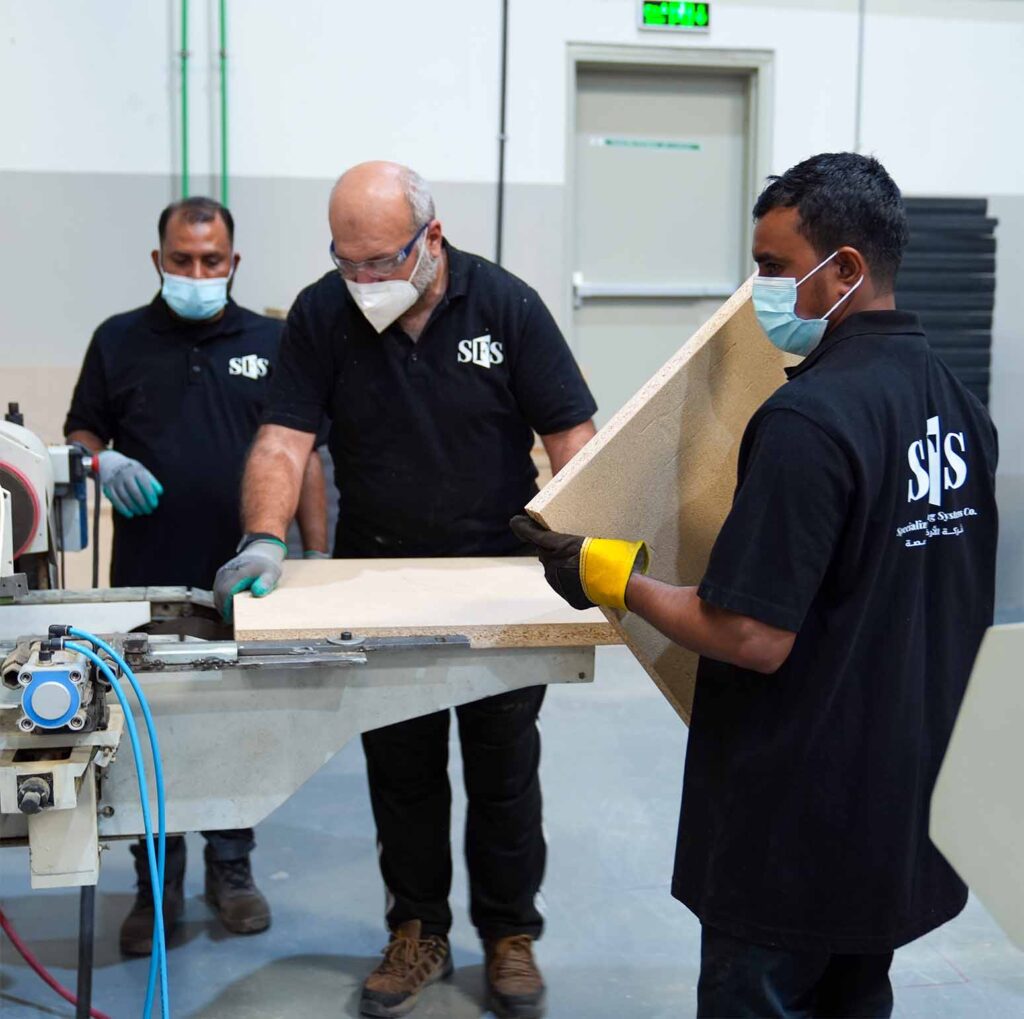
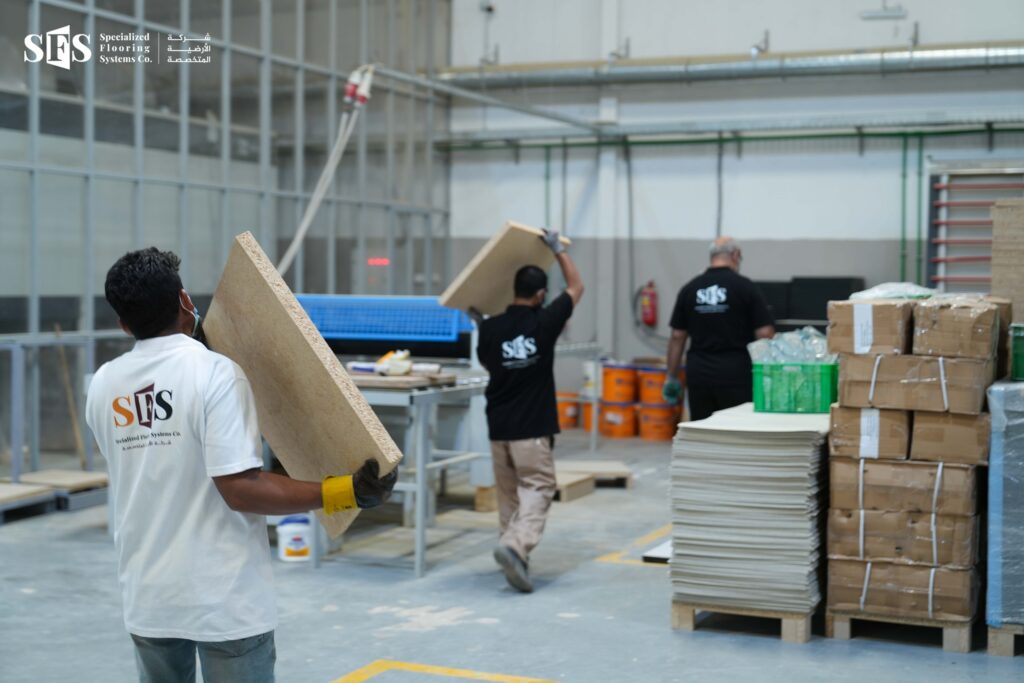
SFS operates advanced manufacturing facilities in Riyadh, Saudi Arabia, producing raised floors using the latest technologies. Local production ensures quality control, rapid customization, and lead times measured in days, not months.
Large Production Capacity
As the largest raised flooring factory in Saudi Arabia, SFS has the production capacity to handle projects of any scale—from small office renovations to hyperscale data centers.
Engineering Expertise
SFS engineers understand structural loads, airflow dynamics, seismic requirements, and regional building codes. They provide load calculations, plenum design recommendations, and compliance documentation.
Strict Quality Control
Every panel is tested to meet international standards (EN 12825, ISO 14644). Load capacity, fire resistance, dimensional accuracy, and surface finish are verified before products leave the factory.
Customized Solutions
SFS engineering team develops custom solutions for unique project requirements: non-standard panel sizes, special load ratings, specific surface finishes, or integration with other building systems.
Reliable Delivery
Local manufacturing and strong supply chain management ensure on-time delivery to project sites across Saudi Arabia and the GCC.
Technical Consultation
SFS provides technical consultation from design through installation, ensuring every system is optimized for its specific application.
Complete Raised Flooring Systems
SFS manufactures a comprehensive range of products: steel cementitious panels, calcium sulphate panels, encapsulated panels, anti-static panels, perforated panels, pedestals, stringers, and accessories.
Professional Installation Support
SFS provides installation supervision and technical support to ensure proper installation. For full turnkey projects, SFS can recommend or supply certified installation teams.
Long-Term Customer Relationships
SFS is committed to long-term partnerships, providing maintenance guidance, spare parts availability, and ongoing support throughout the system’s lifecycle.
Frequently Asked Questions
1. How much does a raised floor cost in Saudi Arabia?
Raised floor cost in Saudi Arabia varies significantly based on panel material, load rating, pedestal height, surface finish, installation complexity, and project size. Material costs typically range from $50 to $150+ per square meter, with complete installed systems priced higher. For an accurate quotation, request a project-specific estimate from a reputable supplier like SFS.
2. What affects raised floor pricing?
Key factors include panel material (steel cementitious, calcium sulphate, or encapsulated), load rating, pedestal height, surface finish, project size, installation complexity, and whether you choose local manufacturing or imported products.
3. Which panel material is most cost-effective?
Encapsulated panels (particleboard core) are the most cost-effective option for offices and light commercial applications with moderate loads. Steel cementitious and calcium sulphate panels have higher initial costs but deliver superior performance and longer service life for demanding applications.
4. Is installation included in the raised floor price?
Installation is typically quoted separately. Professional installation by experienced raised floor contractors is essential for ensuring the system performs as designed. Installation costs vary based on project size, complexity, and site conditions.
5. How is raised floor pricing calculated?
Pricing is typically calculated per square meter, including panels, pedestals, and accessories. Additional costs apply for custom sizes, special finishes, perforated panels, and installation labor. Request a comprehensive quotation that includes all components and services.
6. Can raised floor costs be reduced?
Yes. Accurate project planning, early engineering coordination, selecting appropriate specifications, working with local manufacturers, ordering complete systems, and planning for future expansion can reduce costs without compromising quality.
7. What industries use raised flooring in Saudi Arabia?
Data centers, commercial offices, government buildings, banks, hospitals, control rooms, universities, industrial facilities, telecom facilities, and smart buildings all use raised flooring systems.
8. Why do raised floor quotations vary between suppliers?
Quotations vary due to differences in panel materials, load ratings, finishes, manufacturing quality, certifications, installation services, and whether the supplier is a local manufacturer or an importer. Always compare specifications, not just prices.
9. Is local manufacturing more economical for raised floors in Saudi Arabia?
Yes. Local manufacturing reduces transportation costs, eliminates customs duties, shortens lead times, and provides faster technical support. SFS’s Riyadh-based manufacturing facility offers competitive pricing without compromising quality.
10. How can I request a raised floor quotation?
Contact a reputable supplier like Specialized Flooring Systems (SFS) directly. Provide your project specifications, including area size, load requirements, plenum height, finish preferences, and installation timeline. The SFS team will provide a customized quotation based on your specific requirements.
Conclusion
Understanding raised floor cost in Saudi Arabia requires looking beyond simple price per square meter. The total raised floor price depends on panel material, load rating, pedestal height, surface finish, installation complexity, project size, and whether you choose local manufacturing or imported products. By understanding these factors, you can develop an accurate budget and avoid costly mistakes.
The most cost-effective approach is not simply choosing the lowest initial raised floor price, but selecting the right specifications and a trusted supplier who delivers quality, reliability, and long-term value. Local manufacturing in Saudi Arabia offers significant advantages: shorter lead times, lower transportation costs, better communication, and compliance with Saudi regulations.
For projects across Saudi Arabia and the GCC, Specialized Flooring Systems (SFS) provides the manufacturing capability, engineering expertise, and project experience to deliver raised flooring systems that perform reliably for decades. Local production ensures fast delivery. Quality control guarantees performance. Technical consultation supports every phase of your project.
Contact SFS today for expert consultation, customized recommendations, and a project-specific quotation for your raised flooring requirements in Saudi Arabia.
SEO Meta Information
Meta Title:
Raised Floor Cost in Saudi Arabia 2026 | SFS Pricing Guide
Meta Description:
Complete guide to raised floor cost in Saudi Arabia. Learn about panel materials, load ratings, installation costs, and how to budget for your project.
Focus Keyword:
Raised Floor Cost in Saudi Arabia
Related Keywords:
Raised Floor Price, Access Floor Cost, Raised Floor Price per Square Meter
Internal Linking Opportunities
-
raised-floor-panel-types– using anchor text “raised floor panels” -
raised-floor-specifications– using anchor text “raised floor specifications” -
raised-floor-installation-guide– using anchor text “raised floor installation” -
raised-floor-supplier-saudi– using anchor text “raised floor supplier Saudi Arabia” -
sfs-manufacturing-facility– using anchor text “raised floor manufacturer Saudi Arabia”
Suggested Image Alt Texts
-
“Raised floor installation in Saudi Arabia data center with steel cementitious panels”
-
“Calcium sulphate raised floor panels installed in corporate office in Riyadh”
-
“Raised floor pedestal system showing adjustable height mechanism”
-
“Perforated raised floor panels for data center cold aisle containment”
-
“SFS raised floor manufacturing facility in Riyadh, Saudi Arabia”
-
“Raised floor installation process showing panel placement with suction cup”
-
“Raised floor cost comparison chart showing different panel materials”
-
“Anti-static raised floor panels for electronics protection in data centers”
-
“Encapsulated raised floor panels for commercial office applications”
-
“SFS raised floor project completed in Saudi Arabia government facility”
Suggested External References
-
CISCA (Ceilings & Interior Systems Construction Association)
-
ASTM International Standards
-
ISO 14644 Cleanroom Standards
-
EN 12825 Raised Access Floor Standard
-
Saudi Vision 2030
Key Takeaways Box
-
Raised floor cost in Saudi Arabia varies by material, load rating, finish, and installation complexity
-
Steel cementitious panels offer highest load capacity for data centers and industrial applications
-
Calcium sulphate panels provide superior flatness and acoustics for offices
-
Encapsulated panels are the most cost-effective option for light commercial applications
-
Local manufacturing in Saudi Arabia reduces costs and lead times
-
Professional installation by certified contractors is essential for long-term performance
-
Total cost of ownership matters more than initial price
Buyer Checklist: Factors That Affect Raised Floor Cost
- □
Panel material (steel cementitious, calcium sulphate, or encapsulated)
- □
Concentrated load rating (6-10 kN for offices, 12.5-20+ kN for data centers)
- □
Uniform load rating (UDL in kg/m²)
- □
Pedestal height (plenum depth for cables and airflow)
- □
Surface finish (HPL, vinyl, carpet, anti-static, or ceramic)
- □
Perforated panels required for UFAD cooling
- □
Anti-static properties required for ESD protection
- □
Fire resistance rating required by building code
- □
Project size and economies of scale
- □
Installation complexity (edge panels, obstacles, ramps)
- □
Project location and transportation costs
- □
Local manufacturing vs imported products
- □
Installation labor and supervision
- □
Spare parts availability and after-sales support
Comparison Table: Raised Floor Material vs Cost vs Performance
| Panel Type | Relative Cost | Load Capacity (Concentrated) | Fire Resistance | Acoustic Performance | Ideal Applications |
|---|---|---|---|---|---|
| Steel Cementitious | High | 12.5 – 20+ kN | Excellent (60+ min) | Poor | Data centers, industrial, heavy equipment |
| Calcium Sulphate | High | 10 – 15 kN | Excellent (60+ min) | Excellent | Corporate offices, call centers, cleanrooms |
| Encapsulated | Low | 6 – 10 kN | Limited (combustible) | Good | Offices, retail, light commercial |
| Aluminum | Very High | Moderate | Good | Moderate | Cleanrooms, exterior applications |