The Role of Raised Floors in Modern Saudi Projects
Saudi Arabia is undergoing a construction and digital metamorphosis that is redefining its skyline and infrastructure. Propelled by the ambitious Vision 2030, the Kingdom is rapidly evolving into a global nexus for technology, finance, and innovation. In this dynamic landscape, where futuristic cities rise and data becomes a critical national asset, the very foundations of buildings require a new kind of intelligence. Enter Raised Floor Systems—a transformative architectural solution that is fast becoming essential, not optional, for modern Saudi projects.
These sophisticated systems are the unseen engine of efficiency, flexibility, and safety in today’s most demanding environments. From the humming server halls of massive data centers supporting the nation’s digital economy to the agile workspaces of corporate headquarters in Riyadh and Jeddah, Raised Floors provide the critical infrastructure that allows technology to evolve and businesses to adapt without constraint. They are a direct response to the needs of a nation building for the future: a solution that manages complexity, enhances sustainability, and ensures that Saudi Arabia’s buildings are as smart and forward-looking as the vision they serve.
What Are Raised Floor Systems?
A Raised Floor System, also commonly referred to as an access floor, is a modular, elevated structural floor installed above a building’s base concrete slab. It creates a hidden yet fully accessible void space, known as a plenum, between the structural floor and the finished walking surface. This ingenious design is what unlocks a multitude of functional benefits.
The system is composed of three core components working in concert:
- Panels:These are the visible, walkable tiles, typically measuring 600mm x 600mm. They are engineered with high-strength cores and can be finished with a variety of materials like high-pressure laminate (HPL), vinyl, or carpet to match any interior design.
- Pedestals:These adjustable vertical supports, usually made of steel, are fastened to the base floor. They determine the height of the raised floor and allow for perfect leveling across an entire space, compensating for any irregularities in the subfloor.
- Stringers:These horizontal braces connect the heads of the pedestals, adding crucial lateral stability to the entire grid and increasing the system’s load-bearing capacity, especially important under heavy, concentrated weights.
Why Raised Floors Are Critical in Saudi Arabian Projects
The unique context of Saudi Arabia amplifies the importance of Raised Floor Systems. The Kingdom’s climate presents a significant challenge, with extreme heat making cooling a primary operational cost and concern for any facility. Raised Access Floors directly address this by enabling highly efficient Underfloor Air Distribution (UFAD), which can dramatically reduce HVAC energy consumption—a key priority for both economic and sustainability goals.
Furthermore, Vision 2030’s emphasis on digital government (e.g., smart cities like NEOM and The Line) and a diversified economy has triggered an explosion in data-intensive and technology-reliant projects. These facilities demand infrastructure that is inherently flexible, secure, and capable of rapid change. Raised Floors in Saudi Arabia provide the foundational agility for government hubs, financial trading floors, and telecom centers to upgrade and reconfigure with minimal downtime. In essence, they future-proof the nation’s architectural investments against the relentless pace of technological obsolescence.
Key Benefits of Raised Floors
Superior Cable Management
The underfloor plenum acts as a organized, protected highway for all services. Power cables, data networking lines, and fiber optics are neatly routed and segregated beneath the floor, eliminating the tripping hazards and visual clutter of exposed wires. This ensures a cleaner, safer, and more professional environment, particularly vital in office raised floors and control rooms.
Optimized Ventilation & Airflow
This is a game-changer for climate control. In data center flooring, the plenum serves as a pressurized cold air chamber, delivering cooling directly to the intakes of server racks with pinpoint accuracy. This method is far more efficient than traditional overhead cooling, reducing energy use by 20-30% and directly combating the challenges of the regional climate.
Unmatched Flexibility and Scalability
Raised Floor Systems are the epitome of adaptable design. When office layouts need to change or new technology requires additional cabling, panels can be lifted and reinstalled with ease. This allows for seamless reconfigurations, department moves, and tech upgrades without the dust, debris, and major disruption of traditional construction, protecting the long-term value of the building.
Enhanced Safety and Organization
Beyond trip hazards, specialized anti-static raised floors are engineered to dissipate electrostatic discharges, protecting sensitive servers and electronic equipment from costly damage. The sealed system also prevents dust and debris from accumulating in service areas, contributing to better indoor air quality and a cleaner operational environment.
Long-Term Cost Efficiency
While the initial investment may be higher than a traditional slab, the Total Cost of Ownership (TCO) is significantly lower. Savings are realized through reduced energy bills, minimal maintenance costs, and the complete avoidance of expensive, invasive renovations for future infrastructure changes. It is an investment in operational resilience and financial predictability.
Types of Raised Floor Systems
Selecting the right type of system is paramount to performance. The main categories include:
Cementitious Raised Floors: Constructed with a core of cement and other aggregates, these panels offer exceptional load-bearing capacity and superior fire resistance. They are the ideal choice for areas with very heavy static equipment, such as server rooms and industrial settings.
Calcium Sulphate Raised Floors: These feature a core made from recycled gypsum, offering excellent environmental credentials. They provide outstanding fire performance, high surface flatness, and good acoustic insulation, making them a popular choice for modern offices, call centers, and commercial spaces.
Encapsulated Raised Floors: In these systems, the core (whether cementitious or calcium sulphate) is fully encased in a protective steel shell. This encapsulation provides maximum durability, moisture resistance, and edge protection, offering an extended lifespan in a variety of environments.
Anti-Static Raised Floors: Specifically engineered for environments housing sensitive electronics, these floors incorporate conductive materials (like carbon fibers) or static-dissipative layers. They safely channel electrostatic charges to ground, protecting equipment in data labs, server rooms, financial trading floors, and healthcare settings.
Perforated & Grated Raised Floors: These are specialized panels designed as part of the HVAC strategy. Perforated panels allow conditioned air to flow from the plenum into the room, while grated panels offer high-volume airflow, both essential for effective temperature management in IT spaces and areas requiring precise climate control.
Applications of Raised Floors in Saudi Arabia
The versatility of Raised Floor Solutions makes them indispensable across Saudi Arabia’s key sectors:
- Data Centers:The quintessential application, where they manage extreme cable densities and enable precision cooling, which is non-negotiable for server uptime and energy efficiency in the region.
- Office Buildings:Modern, flexible workspaces in Riyadh’s King Abdullah Financial District or Jeddah’s corporate towers utilize office raised floors to empower agile working, simplify IT deployments, and maintain a sleek, wire-free aesthetic.
- Banks & Financial Institutions:Trading floors, server rooms, and operation centers require the security, static control, and unparalleled accessibility provided by anti-static raised floors to ensure uninterrupted global financial operations.
- Government Facilities:From smart city command centers to ministerial IT departments, government projects demand secure, reliable, and adaptable infrastructure that can evolve with digital service platforms.
- Control Rooms & Telecom Centers:These 24/7 nerve centers, critical to national infrastructure, rely on raised access floors for continuous, zero-disruption access to the vital systems and cabling beneath.
Raised Floors vs Traditional Flooring
|
Feature |
Raised Floor Systems |
Traditional Fixed Flooring |
|
Flexibility |
Exceptional. Easy, non-destructive access to services for endless reconfiguration. |
Very Limited. Changes require disruptive cutting, chasing, and repair. |
|
Maintenance |
Fast & Simple. Lift a tile for immediate access to cables and pipes. |
Slow, Costly & Disruptive. Often involves breaking concrete and major restoration. |
|
Lifecycle Cost |
Lower (TCO). Higher initial cost offset by long-term savings on energy, moves, and changes. |
Higher (TCO). Lower initial cost, but frequent, expensive renovations drive up long-term cost. |
|
Safety & Specialization |
Advanced. Can integrate fire ratings, anti-static properties, and enhanced air management. |
Basic. Limited ability to incorporate specialized performance features. |
|
Future-Proofing |
Built-in. Designed from the outset to accommodate unknown future technologies. |
Obstructive. Often acts as a barrier to technological upgrades and space redesign. |
This comparison clearly shows that Raised Floors are a strategic investment in a building’s long-term functionality and value, whereas traditional flooring is often a short-term, limiting solution.
Importance of Local Expertise in Raised Floor Systems
For projects in Saudi Arabia, partnering with a provider who has deep local expertise is not an advantage—it’s a necessity. A Raised Floor Manufacturer with a footprint in the Kingdom understands the specific regulatory landscape, climatic demands, and cultural nuances of project execution. Local expertise translates into:
- Adherence to Local Standards:Ensuring all materials and installations comply with Saudi building codes and authority requirements.
- Respect for Project Timelines:Local manufacturing and supply chains drastically reduce lead times and eliminate shipping delays, keeping fast-track Vision 2030 projects on schedule.
- Tailored Customization:The ability to visit sites, understand unique challenges, and engineer solutions that fit precise local environmental and architectural needs.
- Reliable After-Sales Support:Immediate access to technical support, maintenance teams, and spare parts guarantees the system performs flawlessly for its entire lifespan.
Specialty Flooring (SFS): Your Trusted Raised Floor Partner
Navigating the complexities of Raised Floor Systems in Saudi Arabia requires a partner with proven capability and local commitment. Specialized Flooring Systems (SFS) has established itself as that trusted partner, combining international engineering standards with on-the-ground Saudi expertise.
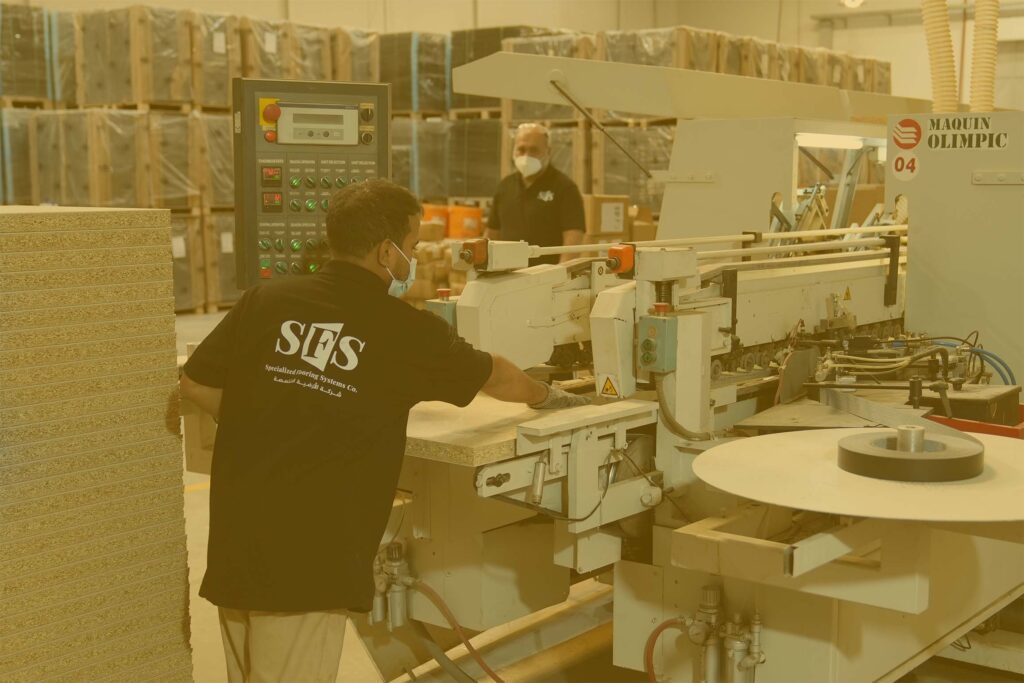
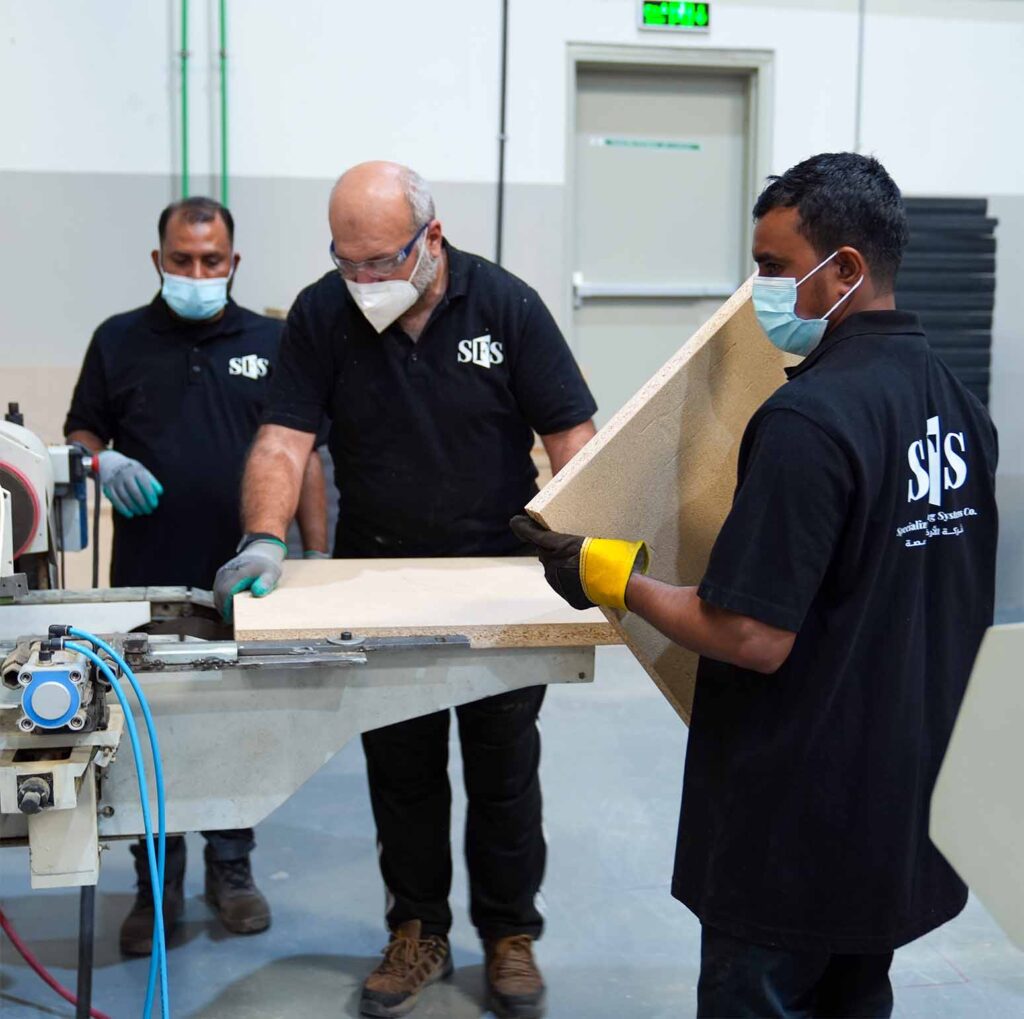
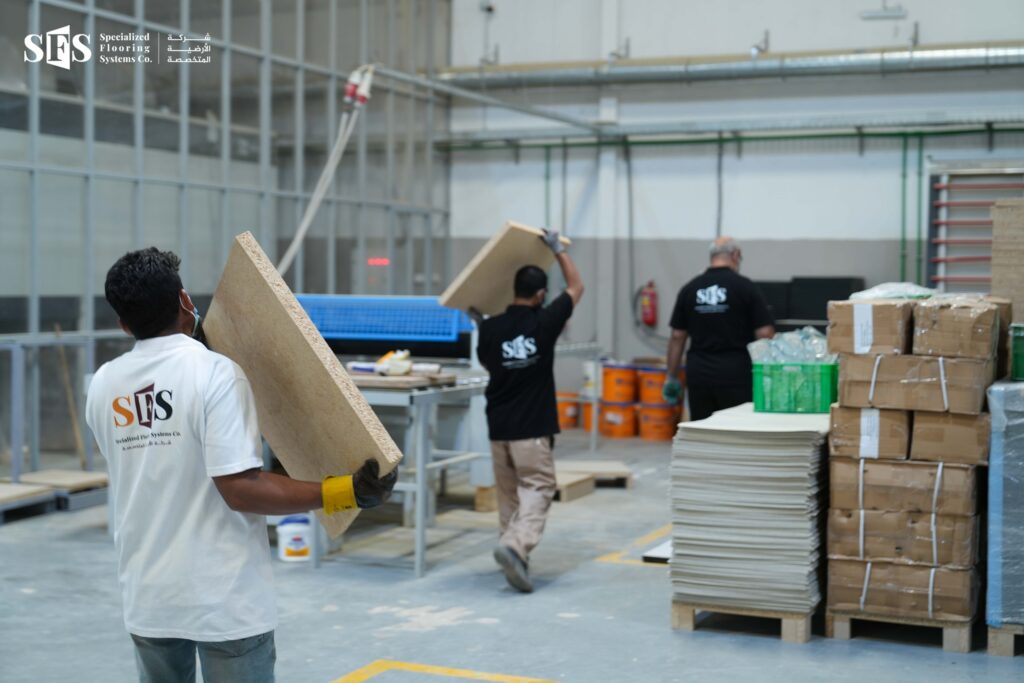
SFS distinguishes itself through its integrated approach. As a Raised Floor Manufacturer with advanced local production facilities, SFS maintains complete control over quality, customization, and supply chain agility. Their team of engineers doesn’t just sell products; they design solutions tailored to the specific load, environmental, and technical requirements of each project—be it a hyperscale data center in KAEC or a flagship bank headquarters in Riyadh.
With a portfolio that spans the most demanding sectors of the Saudi economy, SFS’s focus is on delivering performance, reliability, and peace of mind. They understand that a raised floor is a long-term investment in a building’s operational backbone, and they build every system to last.
Quality Standards & Performance Requirements
The performance of a Raised Floor System hinges on rigorous engineering and testing. Reputable providers like SFS adhere to a stringent framework:
- Load Testing:Panels are tested for Uniformly Distributed Load (UDL) and Concentrated Load to ensure they can support the intended use, from office furniture to heavy server racks.
- Fire Resistance:Core materials and assemblies are tested to international fire ratings, crucial for compartmentalization and life safety in buildings.
- Dimensional Accuracy & Stability:Precision in manufacturing ensures panels fit perfectly, create a level surface, and maintain integrity under load and over time.
- Anti-Static Performance:For ESD-protected areas, floors are tested to standards like ANSI/ESD S20.20 to verify their charge-dissipation capabilities.
- International Compliance:Alignment with standards such as ISO 14644 (cleanrooms) and EN 12825 (European raised access floor standard) provides an objective benchmark for quality.
Sustainability & Raised Floors
In an era focused on green building, Raised Floor Systems contribute significantly to sustainable design goals in Saudi Arabia:
- Energy Efficiency:The ability to implement Underfloor Air Distribution (UFAD) systems can drastically reduce the energy required for cooling, a major contributor to a building’s carbon footprint and operational cost.
- HVAC Optimization:By separating air delivery from lighting and other ceiling services, raised floors allow for more efficient and modular HVAC design.
- Reduced Renovation Waste:The modular nature means spaces can be reconfigured and updated by reusing panels, minimizing construction and demolition waste sent to landfills.
- Long Lifecycle Benefits:The durability and adaptability of a raised floor extend the useful life of a building’s interior fit-out, delaying the need for capital-intensive full renovations.
Frequently Asked Questions (FAQ)
- What exactly are Raised Floors?
Raised Floors are modular, elevated floor systems that create an accessible space (plenum) beneath them for routing cables, pipes, and air distribution. They consist of panels, pedestals, and stringers, and are essential for flexible, modern buildings. - Are raised floors only for IT rooms, or are they suitable for regular offices?
They are excellent for offices. Modern office raised floorsprovide ultimate flexibility for reconfiguring workspaces, simplify the addition of power and data to any desk, and maintain a clean, professional look free of cable trails. - How long does a raised floor system typically last?
A high-quality system from a reputable manufacturer like SFS, properly specified and maintained, has a service life of 25 years or more, making it a permanent and valuable asset to the building. - Are raised floors safe? Are they stable to walk on?
Yes, when engineered and installed correctly. They are designed to meet stringent load-bearing standards for both distributed weight (people, furniture) and concentrated loads (server racks). Anti-slip finishes and secure panel locking mechanisms enhance safety. - Can raised floors support the weight of heavy equipment like server racks?
Absolutely. This is a primary function. Systems are rated for specific Concentrated Loads (e.g., 12 kN, 15 kN). A professional supplier will specify the correct panel and pedestal type to safely support your heaviest equipment. - Why is it important to choose a professional supplier like SFS?
A professional supplier provides end-to-end expertise: correct system design, quality-assured manufacturing, certified installation, and long-term support. This ensures optimal performance, compliance with standards, and protection of your investment, unlike generic or imported solutions that may fail to meet local demands.
Conclusion & Call to Action
In the rapidly evolving architectural and technological landscape of Saudi Arabia, Raised Floor Systems have emerged as a critical enabler. They are the smart, responsive foundation that allows buildings to meet the demands of today while remaining agile for the challenges of tomorrow. From ensuring the efficiency of a national data center to empowering the flexibility of a cutting-edge workspace, the strategic value of a well-designed raised floor is immense.
When the success of your project depends on this foundational choice, partnering with an expert is paramount. Specialty Flooring (SFS) offers more than just product; they offer a partnership grounded in local manufacturing, international engineering standards, and a deep understanding of Saudi Arabia’s unique project requirements.
Invest in a foundation that builds possibilities. For a consultation on integrating the right Raised Floor System into your next project in Saudi Arabia, reach out to the specialists at SFS. Let their expertise guide you to a solution that delivers performance, durability, and lasting value